African leaders urged to strengthen governance systems

African leaders have been urged to build strong governance ecosystems capable of driving sustainable development across the continent.
Professor Thomas Kwasi Teiku of the Department of Politics and International Relations at King’s Western University, Canada, made the call, stressing that such systems should promote institutional interdependence and reorient governance structures to prioritise equity, inclusion and foresight analysis.
He further emphasised the need to establish institutions dedicated to addressing intergenerational gaps at the local, national, regional, continental and global levels, as part of efforts to promote sustainable governance.
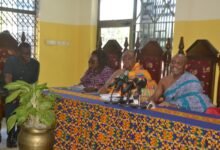
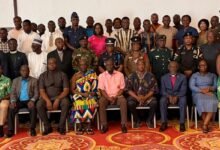
Prof. Teiku made these remarks at a conference held at the University of Ghana (UG), Legon, in Accra yesterday, to mark the end of the six-year main funding phase of the Sustainable Governance research programme of the Merian Institute for Advanced Studies in Africa (MIASA).

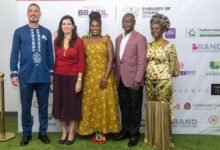
The three-day conference, on the theme: ‘Transitions: Past, Present and Future of Sustainable Governance in Africa,’ brought together current and former fellows of the institute, as well as academics, scholars and researchers.
It also formed part of UG’s 2026 Day of Scientific Renaissance of Africa and featured panel and roundtable discussions on sustainable democracy, sustainability transformation and sustainable peace.
Prof. Teiku observed that the inability of many African countries to effectively address conflicts largely stemmed from the absence of strong governance ecosystems across all levels.
He noted that although African societies had invested significant political, financial, diplomatic and intellectual resources into building peace including the establishment of military, intelligence, police and judicial systems, as well as constitutions and electoral frameworks violence remained prevalent.
He added that beyond physical violence, other forms such as symbolic and structural violence continued to persist in various forms.
Prof. Teiku cited youth unemployment, poverty and inequitable distribution of resources as examples, describing them as a “lifetime war” that the continent must confront.
According to him, a sustainable governance ecosystem required mutually reinforcing institutions operating across five levels local, state, regional, continental and global working in close collaboration rather than in isolation.
The German Deputy Ambassador, Ms Sivine Jansen, also indicated that international discourse on Africa had long been shaped by questions of whose voices were heard and who defined key concepts.
She noted that MIASA had sought to challenge that narrative by creating a platform for knowledge production based on equitable partnerships with African scholars and institutions.
The Vice-Chancellor of the University of Ghana, Professor Nana Aba Appiah Amfo, in a speech read on her behalf by the Provost of the College of Health Sciences, Professor Alfred Edwin Yawson, reaffirmed the university’s commitment to strengthening its partnership with MIASA and similar institutions.
She indicated that such collaborations would help shape both public and international discourse through advanced research.
In her welcome address, the MIASA Director (Ghana) and Associate Professor of Language and Gender at UG, Prof. Grace Diabah, urged participants to actively engage in the conference and contribute meaningfully to discussions.
BY BENJAMIN ARCTON-TETTEY
Follow our WhatsApp Channel now! https://whatsapp.com/channel/0029VbAjG7g3gvWajUAEX12Q