Curiosity and Presence Without Burden
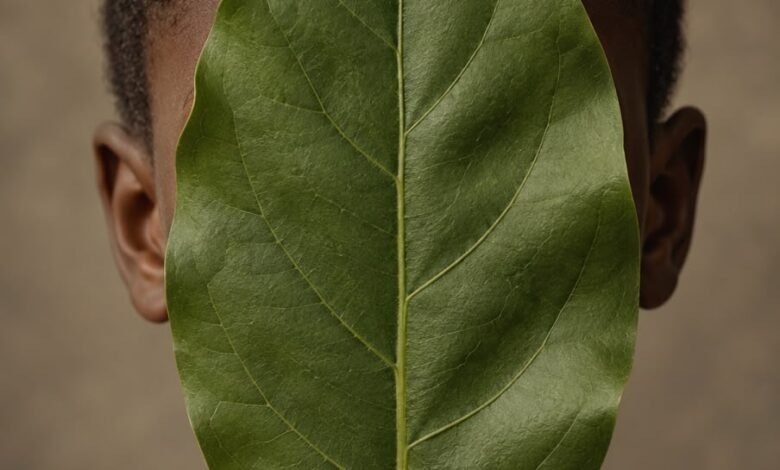
This work by Vivian Ekpokpo was presented in the solo exhibition Echoes of Motherland at Art Native, Port Harcourt, Nigeria, from 15–19 November 2022.
Within this fine art photograph, a single leaf conceals the face of a child. It is a deceptively simple gesture that immediately unsettles the conventions of portraiture. The photograph withholds identity instead of revealing it, asking whether a portrait must always depend on facial recognition. The child remains physically present yet visually anonymous, becoming less an individual subject than a vessel through which memory, ancestry and landscape converge. Rather than inviting immediate familiarity, the image insists on contemplation, allowing silence to become one of its strongest visual elements.
Ekpokpo constructs the photograph with remarkable restraint. The leaf is not introduced as a decorative prop but as an active visual language. Positioned centrally, it assumes the role traditionally occupied by the face, transforming nature into both mask and mirror. Its rich veins echo the invisible networks that connect generations, while its organic surface suggests growth, healing and continuity. The photograph refuses spectacle. Instead, it derives its power from careful reduction, demonstrating how the absence of expression can sometimes communicate more profoundly than its display.
The composition is governed by precision. The muted earth-toned background withdraws completely, leaving the child, the leaf and the soft texture of worn clothing to occupy the entire emotional space of the image. Every visual decision contributes to an atmosphere of quiet dignity. The close crop removes unnecessary narrative, compelling the viewer to confront the symbolic relationship between humanity and the natural world. There is no dramatic gesture or theatrical lighting; the photograph relies instead on measured balance, allowing form, texture and negative space to carry the weight of meaning.


The title of the exhibition, Echoes of Motherland, resonates deeply within this work. The leaf functions as more than botanical material; it becomes an emblem of origin, suggesting that identity is rooted in the land long before it is defined by social categories. By obscuring the child’s face, Ekpokpo redirects attention from individual likeness to collective inheritance. The work proposes that memory is not always preserved in monuments or written histories but within the landscapes, plants and environments that quietly sustain human existence. The motherland is therefore presented not as geography alone but as a living archive carried across generations.
What distinguishes this photograph is its refusal to explain itself completely. It neither romanticises childhood nor exploits symbolism for decorative effect. Instead, it trusts the viewer to navigate its ambiguities. The child appears vulnerable yet protected, hidden yet unmistakably present. This delicate tension gives the work its emotional intelligence. Ekpokpo demonstrates an understanding that contemporary African photography need not depend on overt cultural markers to articulate identity. Through disciplined composition and conceptual clarity, she creates an image that is intimate without sentimentality and political without rhetoric.
In Echoes of Motherland, Vivian Ekpokpo offers a meditation on belonging that is both personal and universal. The photograph quietly dismantles expectations of portraiture, replacing certainty with reflection and visibility with remembrance. Its enduring strength lies not in what it reveals, but in what it deliberately leaves unseen, allowing identity to emerge as something continually negotiated between self, history and the living world.
By Ozolua Uhakheme