Ghana records trade surplus of $1.3bn in Q2 – GSS
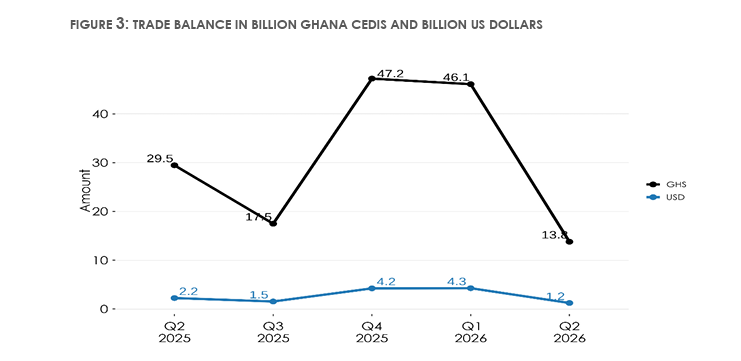
Ghana recorded a trade surplus of $1.3 billion (GH¢13.8 billion) in the second quarter of this year, significantly below the $4.3 billion (GH¢46.1 billion) recorded in the first quarter, the latest Ghana Statistical Service (GSS) Second Quarter Quarterly Trade Report has revealed.
The report, which covers Ghana’s trade in goods between April and June 2026, shows that the country continued to export more goods than it imported during the period under review. However, the surplus fell by about 70 per cent, largely as a result of a sharp increase in imports.
According to the report, Ghana traded GH¢203.2 billion worth of goods in the second quarter, comprising exports of GH¢108.5 billion ($9.6 billion) and imports of GH¢94.7 billion ($8.3 billion), bringing total trade to $17.9 billion.
While exports declined marginally by 1.6 per cent compared with the first quarter, imports increased by 47.5 per cent, significantly narrowing the trade surplus.

The report, however, cautioned that the headline surplus does not tell the full story.
When price changes are removed and trade is measured at constant Q1 2021 prices, exports stood at GH¢26.6 billion, compared with imports of GH¢41.2 billion, resulting in a real trade deficit of GH¢14.6 billion. This compares with a real deficit of GH¢6.2 billion in the first quarter.
Import prices rose by 22.7 per cent between the first and second quarters, more than five times the 4.0 per cent increase in export prices. Fuel was the main driver of the increase, with fuel prices rising by 54.1 per cent.
Gold continued to dominate Ghana’s export earnings, accounting for nearly three out of every four cedis earned from exports.
Gold bullion generated GH¢78.4 billion, representing 72.3 per cent of total exports, up from 57.7 per cent in the first quarter. The top five export products accounted for 89.0 per cent of total exports.
The United Arab Emirates (UAE) emerged as Ghana’s largest export destination, purchasing GH¢32.7 billion worth of Ghanaian goods, representing 30.2 per cent of exports.
Together, the UAE and India accounted for 46.4 per cent of Ghana’s exports, while the top five destinations took 76.2 per cent.
On the import side, mineral fuels and oils accounted for 30.0 per cent of the import bill, with gas oil (diesel) alone valued at GH¢12.2 billion.
China remained Ghana’s largest source of imports at GH¢20.4 billion, although its share declined from 29.7 per cent to 21.5 per cent. South Africa moved into second place with imports valued at GH¢11.8 billion.
Ghana’s trade with Africa also shifted into deficit, with imports of GH¢23.6 billion exceeding exports of GH¢19.2 billion. The GH¢4.4 billion deficit was largely attributed to machinery parts imported from South Africa.
In his preface to the report, the Government Statistician, Dr Alhassan Iddrisu, said the figures provided an important basis for understanding Ghana’s economic position.
“High world prices can flatter the headline, but lasting strength comes from making and selling more,” he said, urging greater attention to export diversification, local processing and wider use of African Continental Free Trade Area (AfCFTA) markets.
He noted that the latest figures showed Ghana’s growing dependence on gold and a relatively small group of export markets.
“A nation that measures well decides well,” Dr Iddrisu said, and stressed that timely and reliable trade statistics was crucial to guide economic decisions.
BY KINGSLEY ASARE
You can now read the *Ghanaian Times* and *The Spectator* newspapers digitally on [TimesNewsPlus](https://timesnewsplus.com/newspapers).
Follow our WhatsApp Channel now! https://whatsapp.com/channel/0029VbAjG7g3gvWajUAEX12Q