Ghana’s Q1 external trade hits GH¢174.6bn – GSS
The total value of Ghana’s external trade reached GH¢174.6 billion ($16.1 billion) in the first quarter (Q1) of 2026, comprising exports of GH¢110.3 billion ($10.2 billion) and imports of GH¢64.2 billion ($5.9 billion).
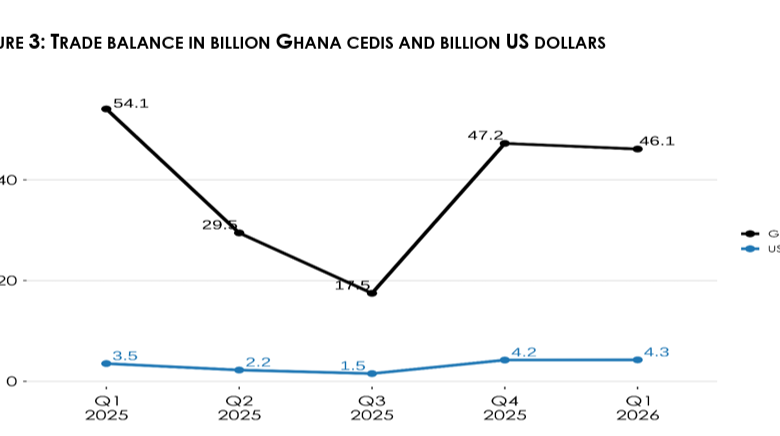
In the same period, Ghana recorded a trade surplus of GH¢46.1 billion ($4.3 billion).
Although this represents a strong positive balance, it reflects a marginal decline of GH¢1.1 billion ($0.1 billion) compared to the GH¢47.2 billion ($4.4 billion) surplus recorded in Q4 2025.
This is contained in Ghana’s provisional International Merchandise Trade Statistics for the first quarter of 2026, released by the Ghana Statistical Service (GSS) in Accra yesterday.
Presenting the report, the Government Statistician, Dr Alhassan Iddrisu, said the headline surplus should be interpreted with some caution because, in real terms, the country recorded a trade deficit during the quarter.
He explained that while nominal exports stood at GH¢110.3 billion, the real value of exports was GH¢28.1 billion, compared with real imports of GH¢34.3 billion.
“This tells us that the strong nominal trade position is not entirely driven by increases in the volume of goods traded. Price movements, particularly in the gold market, have played an important role,” Dr Iddrisu said.
The report indicated that export prices increased by 5.0 per cent year-on-year and 8.5 per cent quarter-on-quarter, largely driven by higher gold prices, while import prices declined significantly.
Gold continued to dominate Ghana’s export basket, generating GH¢63.7 billion ($5.9 billion) during the quarter.
However, its share of total exports fell from 67.5 per cent in Q4 2025 to 57.7 per cent in the first quarter 2026, suggesting early signs of diversification.
Dr Iddrisu said the figures pointed to both opportunities and vulnerabilities in Ghana’s trade structure.
“While the trade surplus is encouraging, it also reminds us of the need to look beyond a few commodities and markets. A resilient trade sector must be able to withstand changes in international commodity prices,” he said.
Dr Iddrisu said Asia remained Ghana’s largest trading region, accounting for 42.6 per cent of exports and 53.3 per cent of imports, with China alone responsible for 29.7 per cent of total imports.
He said the report also showed that Ghana’s trade with Africa continued to improve, with the country maintaining a trade surplus with the continent since Q4 2024. The surplus reached its highest level in Q1 2026.
However, trade within Africa remained concentrated. South Africa accounted for 66.9 per cent of Ghana’s exports to the continent, while Nigeria led Ghana’s imports from Africa with 32.9 per cent, largely due to mineral fuels and oils.
The GSS said the figures reinforced the need for Ghana to diversify its export products and markets, increase value addition and deepen regional trade under the African Continental Free Trade Area (AfCFTA).
It also called for greater investment in ports, transport and trade logistics, as well as improved access to finance for small and medium-sized enterprises to strengthen their capacity to participate in international trade.
The report noted that rising cocoa earnings and the widening trade surplus with African markets provided opportunities for Ghana to expand beyond its traditional dependence on raw commodity exports.
It urged government and industry players to focus on processed and higher-value products, particularly in the cocoa and minerals sectors, to make trade a stronger and more sustainable contributor to economic growth.
BY KINGSLEY ASARE
You can now read the *Ghanaian Times* and *The Spectator* newspapers digitally on [TimesNewsPlus](https://timesnewsplus.com/newspapers).
Follow our WhatsApp Channel now! https://whatsapp.com/channel/0029VbAjG7g3gvWajUAEX12Q