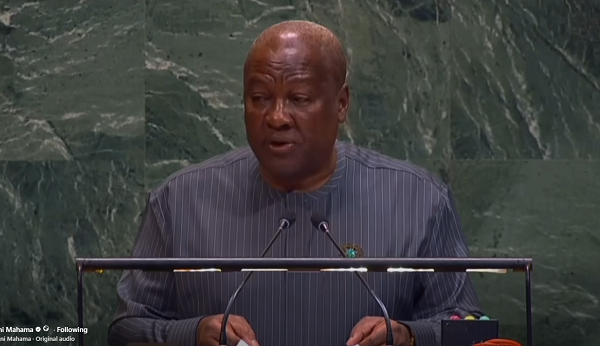
President John Dramani Mahama’s draft resolution to have the transatlantic slave trade declared the gravest crime against humanity has been adopted.
The motion received overwhelming support from member states during voting at the United Nations Headquarters in New York, United States, yesterday. At the end of the debate, 123 countries voted in favour of the resolution, with three voting against and 52 abstaining.
The resolution was backed by regional blocs, including Africa, the Caribbean Community (CARICOM), and Asia-Pacific countries. The countries that voted against were led by the United States, while the European Union and another permanent member of the Security Council, France, abstained.
Presenting the resolution on behalf of President Mahama and the African Group ahead of the vote, the Minister for Foreign Affairs, Mr Samuel Okudzeto Ablakwa, urged member states to support the motion, explaining that it sought to strengthen global efforts to combat racism, racial discrimination, and xenophobia in all its forms.


“This resolution does not create legal hierarchies of crime as some have wrongly suggested; neither is it about reopening history. It is about completing history. It does not target individual states, nor does it seek division. Rather, it establishes a principled framework for reconciliation grounded in truth.
“At its heart, this draft resolution is forward-looking and unifying. It is focused on truth, remembrance, education, and dialogue. It is grounded not in retribution but in moral recognition,” Mr Ablakwa said, urging the Assembly to vote in favour of it.
Opposing the motion, the United States argued that the use of the term “gravest” in the resolution sought to create legal hierarchies of crimes. According to the US representative, the resolution pursued a narrow and specific agenda that ran counter to the UN Charter.
“While we acknowledge the horrors of the past, we do not accept this resolution’s assertion that historical acts from the 15th to the 19th century constitute violations under modern legal standards. The US also does not recognise a legal right to reparations for historic wrongs that were not illegal in international law at the time they occurred.
“In addition to its legal problems, this resolution is also unclear as to who the recipients of reparatory justice will be. The drafters and supporters of this resolution seem to believe it is them.
“The US strongly objects to the cynical use of historical wrongs as leverage in an attempt to reallocate modern resources to people and nations distantly related to the historical victims,” he said.
He described as “arbitrary” the account of history in the resolution, arguing that the trafficking of enslaved Africans began long before the 15th century and, regrettably, continued beyond the 19th century.
On behalf of the European Union, a representative condemned the transatlantic slave trade and said there was a need to learn from history. She noted that the Union’s recently adopted anti-racism strategy underscored its commitment to addressing the enduring legacy of slavery.
“This resolution was presented as a forward-looking and unifying process. It offers a meaningful opportunity to foster unity among UN member states to jointly address an issue of paramount importance for all.
“Regrettably, we were not able to reach a consensual outcome within the short timeframe allocated for negotiations. We also regret that the proponents of the resolution did not reconsider their approach despite our repeated calls for constructive engagement,” she said.
She added that the final text did not reflect their position on key issues, for which reason they chose to abstain.
BY JULIUS YAO PETETSI
Follow our WhatsApp Channel now! https://whatsapp.com/channel/0029VbAjG7g3gvWajUAEX12Q
Follow our WhatsApp Channel now! https://whatsapp.com/channel/0029VbAjG7g3gvWajUAEX12Q