Inflation edges up to 5.2% in September — GSS
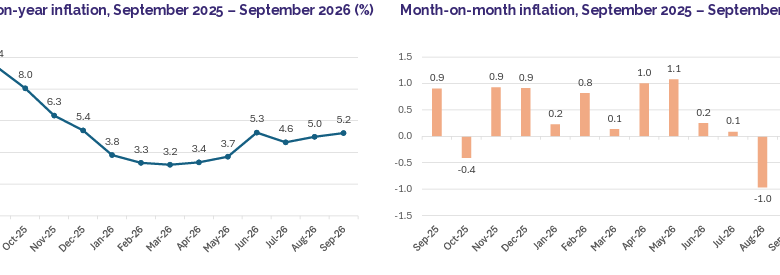
GHANA’S inflation rate rose marginally to 5.2 per cent in September, from 5.0 per cent in August, driven by non-food inflation, the Ghana Statistical Service (GSS) has announced.
On a month-on-month basis, prices increased by 1.1 per cent during the month of September.
The Government Statistician, Dr Alhassan Iddrisu, announced the figures at a news conference in Accra yesterday to release the September Consumer Price Index (CPI).
He said although inflation had risen slightly from August, the latest figure was still 4.2 percentage points lower than the 9.4 per cent recorded in September 2025.


“This means that inflation has nearly halved over the past year, but we are seeing some upward movement in prices again,” Dr Iddrisu said.
The CPI, with 2021 as the base year, stood at 271.5 points in September, compared with 258.0 points in September 2025.
Dr Iddrisu explained that non-food items accounted for 63.3 per cent of total inflation, while food contributed 36.7 per cent.
Dr Iddrisu said non-food items continued to exert greater pressure on the overall inflation rate than food, indicating that non-food inflation stood at 6.2 per cent in September, although it declined from 6.8 per cent in August.
Food and non-alcoholic beverages inflation, meanwhile, increased to 4.0 per cent, from 3.0 per cent in August.
“In simple terms, of every one Ghana cedi of price increase recorded in September, about 63 pesewas came from non-food items and 37 pesewas from food,” he said.
He said food inflation increased by 1.5 per cent month-on-month, reversing the 2.6 per cent decline recorded in August.
The Government Statistician, however, said some major food staples remained cheaper than a year ago, with lime prices falling by 29.9 per cent, maize by 26.4 per cent and Bambara beans by 21.7 per cent.
He said services also remained the most persistent source of inflationary pressure, explaining that services inflation stood at 8.3 per cent, compared with 8.6 per cent in August, while goods inflation was 4.2 per cent, up from 3.8 per cent.
Dr Iddrisu said housing, water, electricity, gas and other fuels recorded inflation of 10.3 per cent and contributed 25.6 per cent of total inflation.
The Government Statistician said inflation for locally produced items rose to 6.4 per cent, from 6.1 per cent in August, while imported inflation increased slightly to 2.4 per cent, from 2.2 per cent.
He said locally produced items accounted for 85.7 per cent of total inflation, indicating that the relatively low imported inflation reflected the benefit of a more stable cedi, which was helping to moderate the cost of imported goods.
On regional inflation, Dr Iddrisu said the Ashanti Region recorded the highest inflation at 9.8 per cent, while the Western Region recorded the lowest at -0.5 per cent, indicating a decline in prices there.
The Ashanti and Greater Accra regions together accounted for 56.6 per cent of the national inflation rate.
BY KINGSLEY ASARE
Read the *Ghanaian Times* and *The Spectator* newspapers digitally on [TimesNewsPlus](https://timesnewsplus.com/newspapers).
Follow our WhatsApp Channel now! https://whatsapp.com/channel/0029VbAjG7g3gvWajUAEX12Q