Is HIV really rising in Ghana? What the data says before the festive season

HEADLINES in Ghana sometimes raise concerns about rising HIV infections. But what do the numbers really tell us? At the national level, the latest estimates show that new HIV infections and deaths from AIDS have continued to decline. This is encouraging, but it does not mean Ghana has the epidemic under control. Significant gaps remain in preventing new infections, getting more people tested and ensuring that everyone living with HIV receives treatment. The figures come from the UNAIDS 2026 estimates and the Ghana AIDS Commission’s 2025 National HIV Estimates, released in July 2026.
Understanding HIV and AIDS
Human immunodeficiency virus (HIV) attacks the body’s immune system, weakening its ability to fight infections. Acquired immunodeficiency syndrome (AIDS) is the most advanced stage of HIV infection and can develop when HIV is not effectively treated.
HIV can be transmitted through unprotected vaginal or anal sex, contact with infected blood, sharing contaminated needles, and from mother to child during pregnancy, childbirth or breastfeeding. It does not spread through hugging, sharing food or mosquito bites.
Antiretroviral therapy (ART) helps control HIV by reducing the amount of virus in the body. People who take their treatment consistently can live long, healthy lives. Those who achieve and maintain an undetectable level of HIV through effective treatment do not transmit the virus through sex.
Globally
About 41 million people were living with HIV worldwide in 2025. An estimated 1.2 million people acquired the virus that year, while 570,000 died from AIDS-related illnesses. Globally, new HIV infections have fallen by 65 per cent since their peak in 1994, while AIDS-related deaths have declined by 73 per cent since their peak in 2004.
However, progress has not been equal everywhere. UNAIDS warns that declining international funding threatens HIV prevention programmes, particularly in countries that rely heavily on donor support.
Africa
Sub-Saharan Africa still accounts for about half of all new HIV infections worldwide, although new infections in the region have fallen by 59 per cent since 2010. The challenge now is sustaining this progress amid declining funding.
International donors provided about 80 per cent of funding for HIV prevention in the region, but much of this support was cut in 2025. UNAIDS also reported a 38 per cent decline in the number of people receiving pre-exposure prophylaxis (PrEP), medicine taken by people who do not have HIV to reduce their risk of acquiring it, across 62 reporting countries between 2024 and 2025.
What the numbers say about Ghana
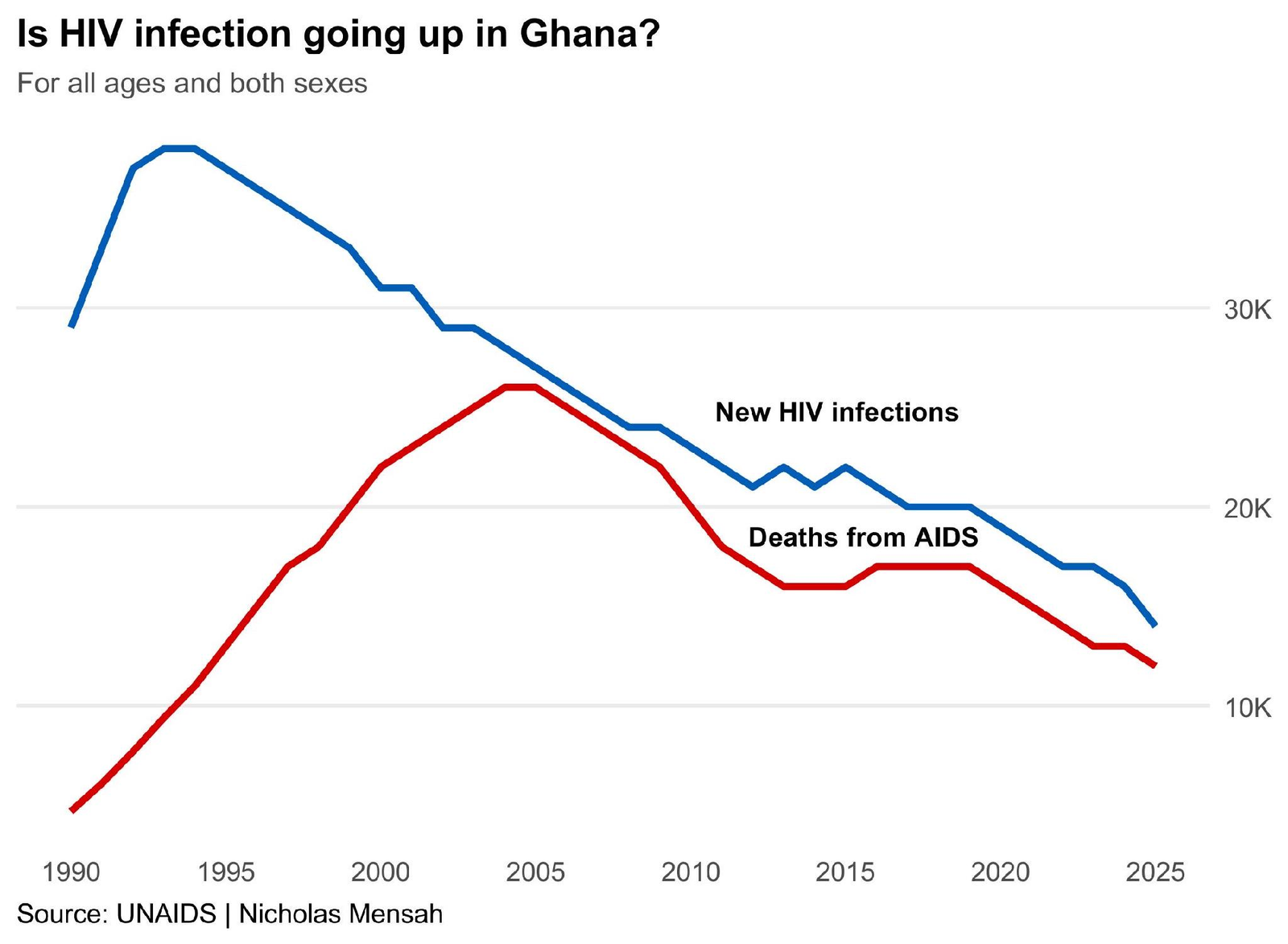
The visual above, based on UNAIDS 2026 estimates, shows trends in Ghana from 1990 to 2025. New HIV infections peaked at about 38,000 a year in the early 1990s but have since fallen to around 14,000. AIDS-related deaths peaked at approximately 26,000 a year in the mid-2000s and have also declined, reaching around 12,000 in 2025.
Ghana’s latest estimates show that new HIV infections fell from 16,189 in 2024 to 13,951 in 2025, a reduction of about 14 per cent. AIDS-related deaths also declined, from 13,429 to 12,051, representing a fall of approximately 10 per cent.
The percentage of adults aged 15 to 49 living with HIV fell from 1.79 per cent in 2015 to 1.40 per cent in 2025. Despite this progress, an estimated 337,435 people were living with HIV in Ghana in 2025.
Although these figures show encouraging progress, they do not tell the whole story. Important gaps in prevention, testing and treatment remain and require urgent attention.
Why concern remains
Despite the decline in new infections, four concerns require urgent attention.
First, the number of new infections remains high. Ghana recorded an estimated 13,951 new HIV infections in 2025, equivalent to about 38 new infections every day. This is a reminder that the country cannot afford to slow its prevention efforts.
Second, young people remain significantly affected. An estimated 3,835 new infections occurred among people aged 15 to 24 in 2025, representing about 27.5 per cent of the national total. Although this figure was lower than in 2024, it highlights the need for accessible sexual health education, testing and prevention services for young people across Ghana.
Third, some communities face a greater burden than others. The Eastern Region has the country’s second-highest adult HIV prevalence, at 1.83 per cent, following Greater Accra. Lower Manya Krobo in the Eastern Region has the highest reported district-level prevalence, at 5.08 per cent. These differences highlight the importance of directing resources towards communities with the greatest needs.
Fourth, testing and treatment remain below global targets. Ghana’s progress stands at 70-81-92, against the global target of 95-95-95. This means that about 70 per cent of people living with HIV know their status. Of those who know their status, about 81 per cent are receiving treatment. Of those receiving treatment, about 92 per cent have reduced the virus in their bodies to very low levels. An estimated 101,000 people living with HIV in Ghana may not yet know their status.
The diagnosis gap is particularly important. People who do not know they have HIV may miss the opportunity to begin treatment and take steps to protect their health and prevent transmission. Expanding confidential testing, linking people who test positive to treatment and reducing stigma are essential to closing this gap.
A festive season reminder
As Christmas and New Year approach, travel, celebrations and social gatherings provide an opportunity to remind Ghanaians about HIV prevention. However, there is insufficient evidence to conclude that new HIV infections in Ghana increase during December.
HIV prevention matters throughout the year. Abstain from sex if you choose. If you are sexually active, use condoms correctly and consistently, get tested and speak to a qualified health professional about pre-exposure prophylaxis (PrEP) if you may be at risk.
People living with HIV should continue taking their medication as prescribed and plan ahead to avoid running out during the holidays.
The Way Forward
Ghana is making progress towards controlling HIV. The Ghana AIDS Commission projects that new infections could fall to about 6,430 a year by 2030 if prevention, testing and treatment continue to improve. Achieving this goal will depend on sustained funding for these essential services.
As international donor funding for HIV programmes declines, the government must strengthen domestic financing to protect the gains made and ensure that prevention, testing and treatment services remain accessible.
As the world prepares to mark World AIDS Day on December 1, under the theme “Ending AIDS Starts with Access”, Ghana must turn its commitment into action by investing in services that enable more people to know their HIV status, access treatment and protect themselves.
As we prepare to enjoy the festive season, consider taking an HIV self-test or visiting a health facility for testing. If a self-test result is positive, visit a health facility for confirmatory testing and, if diagnosed with HIV, begin treatment promptly. If you test negative, continue to protect yourself. Abstain from sex if you choose or use condoms correctly and consistently if you are sexually active. You can also speak to a qualified health professional about other prevention options, including pre-exposure prophylaxis (PrEP).
Ultimately, preventing HIV requires individual responsibility as well as collective action. Government, health workers, communities and individuals all have a role to play in ensuring that progress continues.
HIV prevention and treatment must not take a holiday.
BY DR NICHOLAS ADDAE MENSAH
The writer is a medical doctor, development economist and health policy analyst at International Perspective for Policy & Governance (IPPG).