The Lunar Passenger
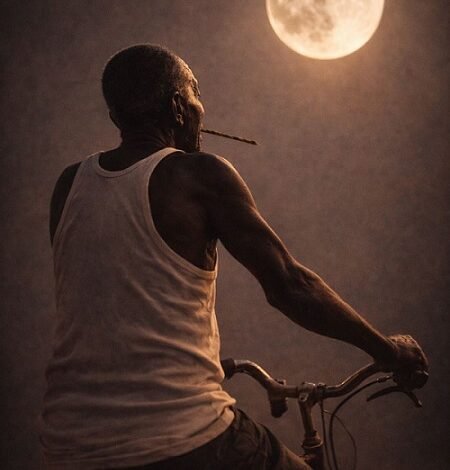
“The Lunar Passenger” is an art piece presented as part of the group exhibition (New Voices in Contemporary Photography), held from April 2nd to 20th, 2025 at Art Place Gallery, Lagos. The art reflects Orisakwe Emmanuel Chizitere’s thoughtful engagement with mood, symbolism, and human experience. The photograph stands as a quiet yet powerful meditation on life, circumstance, and the enduring hope for a better tomorrow.
The image portrays a solitary figure seated on a bicycle, viewed from behind, facing a large and luminous moon. The scene is calm and uncluttered, with the figure placed in the foreground and the glowing moon dominating the background. This simple arrangement creates a strong visual relationship between the human subject and the vast, distant object before him. The choice to show the figure from behind is particularly effective, as it removes individual identity and allows the viewer to step into the subject’s position, making the experience more universal. The photograph is carefully composed.
The balance between the dark silhouette of the figure and the bright presence of the moon creates a striking contrast. The muted tones of the environment further emphasise the glow of the moon, drawing the viewer’s eye towards it as a central point of meaning. The stillness of the scene enhances its reflective quality, suggesting a pause rather than movement, a moment of thought rather than action.
The title, The Lunar Passenger, adds an important layer to the interpretation. The word “passenger” suggests a journey, but not one fully controlled by the individual. It implies that life often carries people along paths shaped by circumstance, beyond their full control. The bicycle, typically a symbol of movement and effort, appears at rest, reinforcing the idea that this is a moment of reflection within a larger journey. Symbolically, the moon plays a central role. It may be understood as a representation of hope, aspiration, or even distant dreams. Its large and almost overwhelming presence suggests something that feels both close and unreachable at the same time. In relation to life’s challenges, the moon can be seen as the promise of something better, a future that one continues to look towards despite present difficulties.


The photograph speaks quietly but clearly about resilience. The lone figure, though still, does not appear defeated. Instead, there is a sense of contemplation, as if he is gathering strength or finding direction. Life’s circumstances may limit movement at times, but they do not remove the ability to hope. In this way, the image becomes a reflection of endurance; the idea that even in stillness, there is a forward-looking spirit. At the same time, the work connects strongly with the theme of hope for a better tomorrow. The act of looking towards the moon suggests belief in something beyond the present moment. It reflects the human tendency to imagine, to dream, and to continue despite uncertainty. The quiet atmosphere of the photograph reinforces this sense of patience, as though change is expected, but not rushed.
However, the simplicity of the image may also be seen as a limitation. The symbolism of the moon as hope or aspiration is widely recognised and may not feel entirely original. Additionally, the highly controlled nature of the composition may reduce a sense of spontaneity, making the image feel more constructed than lived. For some viewers, this could lessen its emotional immediacy. Despite this, The Lunar Passenger remains a compelling and thoughtful work. Its strength lies in its restraint and its ability to communicate complex ideas through minimal elements. Chizitere does not overwhelm the viewer but instead invites quiet reflection, allowing meaning to emerge gradually.
In the final analysis, the art title is a poetic exploration of life’s journey, shaped by circumstance yet sustained by hope. Through careful composition and symbolic depth, Orisakwe presents an image that speaks to resilience and the enduring human desire for a better tomorrow. It is a subtle but meaningful contribution to contemporary photography, offering a moment of stillness in which viewers can reflect on their own paths and possibilities.
By Funke Osae-Brown