The teaching of Arabic in tertiary (public and private) educational institutions in Ghana (1)
As part of the efforts by Muslims in the country to assist the present NDC Government in its efforts to uplift Arabic education, it has become imperative to publish in the press tertiary institutions that are assisting in the production of high-quality Arabic graduates to undertake the teaching of Arabic, especially in the first and second cycle institutions in the country.
First on the list is our premier University of Ghana, Legon. In 1964 Arabic was introduced along with Russian, Spanish and Swahili as part of the department of languages. Currently, the department offers degrees in BA, MA and M.Phil. It is even thinking of extending its degree programmes to the PhD level. It is manned by Dr Muhammad Abbas (Ph.D), Dr Hafiz (Ph.D), Dr Alhassan Hussein (Ph.D) and Dr Muaz (Ph.D) among others. As part of its training programmes students are sent to Arabic countries to acquire further proficiency and experience in the spoken language.
Second on the list is the University of Cape Coast which, I understand, offers tuition in Arabic up to the BA(Ed) in Arabic at the Arabic section of the Department of Languages.
Third, is the University College of Winneba, Kumasi Compus where the Arabic department was established in 2014. Courses offered in the first-degree programme is education and other subject, all of which are taught in English. Only the Arabic language is used in lectures in the teaching of the Arabic language. The first degree is offered as B.Ed Arabic).
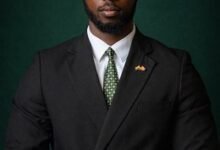
Dr. Mustapha Muaz (Ph.D, Morocco) is the coordinator of Arabic at the Department. Other lecturers include Dr Abbas Shamsun-deen (Ph.D, Saudi Arabia), Mr Yushawa Muhammad Abdullah (M.Phil, Libya). He is currently doing his PhD at the Ilorin University in Nigeria.
Fourth is the Al-Faruq College of Education, Wenchi, Bono Ahafo. It has also began a programme in Arabic leading to B.Ed in Arabic (JHS specification). In other words graduates can only teach at the JHS level.
Fifth is the University of Development Studies, Northern Region. It has also started a programme in B.Ed Arabic (JHS specification).
Sixth is the Beposo College of Education, Beposo in Ashanti. It has also initiated a programme in B.Ed Arabic (JHS specification).
Seventh is the Institute of Higher Islamic Studies, Kumasi, Ashanti. It was established in 1991/1992 with funds by the Saudi Khair organisation. The Institute teaches Arabic, English, Islam, Education, Tarbiyat (Upbringing of children). Tuition fees are paid by Muslim donors and philanthropists. The following Arabic experts have taught at the institute from the Ghana Muslim Mission. Sheikh Uthman Agyemadu, Sheikh Ibrahim Twene, Sheikh Ahmed Appau, Muhammad Sharfdeen, who is a product from the school.
Eighth on the list is the Ghana Institute of Languages (GIL). It was established in 1961 by the first President, President Kwame Nkrumah. It is a premier public institution to the teaching of foreign and local Ghanaian languages. It offers certificates, diplomas and degree courses in Arabic, English, French, German, Portuguese, Russian and Spanish. It has campuses in Accra, Kumasi and Tamale.
The ninth is the Lakeside University College of Science and Technology, Madina, Accra. It was formerly the Madina Institute of Science and Technology and was established in 2013. In 2021, it began a BA programme in Arabic (Ed).
The tenth is the Islamic University College of Ghana, Ajiringanor, Accra. It was established in 2000 by the Ahlul Bait Foundation of Iran. Its programmes include the
teaching of Arabic.
Ahmadiyyat
The Jammiat Ahmadiyyat International, Mankessim was established in 2011 by the Khalifa of the world-wide Ahmadiyyat Jamaat. It admits students from all over the world and trains them in high missionary work. Tuition is in Urdu. It also teaches Arabic and English. It has one of the most beautiful campuses in the country.
Then comes Jammiat Ahmadiyyat Mubasshireen at Ekumfi at Ekrawfo in the Central region. It is a Missionary Training College that was established in 1966 by the Amir Maulana Atta Ullah Kaleem. The location was later moved from Ekwumfi to Ekrawfo in 2003. The Training College also teaches Urdu, Arabic and the English language. Sheikh Alhassan Ahmad is a product from the prestigious Al-Azhar University of Egypt. He has BA and MA in the Arabic language and literature respectively. He joined the Jammiat in 2015 and teaches Arabic grammar, morphology, translation and Quran recitation. Then there is Sheikh Sharfdeen who used to work at the National Headquarters of the Movement in Accra. He has a BA and MA in Quranic Commentary (Tafsir Al-Quran). He obtained the degrees from the Islamic University of Madina, Saudi Arabia. Currently he is doing his Ph.D in Quran’s Commentary at Al-Azhar in Egypt.
Last but not the least is the Nusrat Jahan College of Education in Wa. It was first established in 1982 as a College of Education. It has risen to become a tertiary institute of education in the country and offers tuition in English. I understand they also teach Arabic. With heavy emphasis on the training of Ahmadi Muslims in all fields of human endeavours writes the second Khalifa Bashirudeen: ” God is pulling down these wordly systems gradually and not at one stroke, because those to whom the rebuilding of this structure is to be committed are being trained in the divine academy of engineering and have not yet completed their studies ” (Ahmadiyyat, Renaissance of Islam)
Conclusion
The above discussion is on the collective efforts of the Government and all the
Islamic sects in the training of local Arabic graduates.
KHALID KOFI AHMAD
Follow our WhatsApp Channel now! https://whatsapp.com/channel/0029VbAjG7g3gvWajUAEX12Q