A university of continental standing is paying the price
Executive summary
Ashesi University sits at Berekuso in the Akuapem South District of the Eastern Region, on the foothills of the Aburi ridge. It was founded in 2002 and moved to the Berekuso campus in 2011. It is a private, not-for-profit institution built with private money and philanthropic support, and it now draws students from Nigeria, Kenya, Rwanda, Zimbabwe, South Africa and many other African countries.
The campus cannot be reached by a decent road. From the Kitase junction on the Accra-Aburi road it is about seven kilometres. From Dome-Kwabenya it is about 10. Journeys that should take 10 minutes take 30 to 45. In the dry season the corridor is buried in red dust. In the rains, sections turn to mud.
The state contracted this road four years ago and left it unfinished. The appeal in this article is that His Excellency President John Dramani Mahama establish and publish the true status of Regional Route 98, correct the official record that describes it as completed, and bring the outstanding works to completion under the Big Push programme.

1. A university the taxpayer did not pay for
Ghana did not build Ashesi. Patrick Awuah returned home, raised the money, took the risk and built it on a hillside in a farming town that had never seen an institution of that kind. The state did not fund the lecture halls, the library, the engineering workshops or the student residences.
What the university asked of the state was ordinary. It asked for the public road leading to the campus. The only properly surfaced stretch at Berekuso is the short approach the university paid for itself. A private institution has been made to build public infrastructure because the public authority responsible for it did not deliver.
The principle extends beyond one campus. When a Ghanaian puts private capital into a sector the state struggles to fund, the least the state owes in return is the enabling infrastructure. If that bargain does not hold at Berekuso, where the results are visible and internationally acclaimed, no serious investor in education will believe it holds anywhere.
1. A contract signed in 2022 and a deadline that passed in 2024
The facts are on the public record. On 6 July 2022 the Ministry of Roads and Highways signed a contract with First Sky Limited for the rehabilitation of the 23- kilometre Dome-Kitase road, designated Regional Route 98. The contract sum was about GH$195 million, financed by the Government of Ghana and the Kuwait Fund for Arab Economic Development.
Construction commenced in mid-July 2022 with a presidential sod-cutting, under a twenty-four month programme ending in July 2024. The Ghana Highways Authority was the implementing agency.
The design was detailed and sensible. It provided for about 16.3 kilometres of two- lane single carriageway in asphaltic concrete, a 2.8-kilometre dual carriageway arterial with auxiliary lanes for pick-up and drop-off, and a one-kilometre two-lane carriageway serving Ashesi University, also in asphaltic concrete. The needs of the university were considered and costed.
By early 2023 the contractor was reporting about 35 per cent completion. By 2026 there was no meaningful activity on the Kwabenya to Kitase stretch. Whatever the reasons, and the usual ones are certification delays, payment arrears, utility relocation and compensation disputes, the outcome for the road user is the same.
The road was dug up, left at formation level in places and abandoned to the weather. In several sections the works have made the surface worse than it was before 2022.
3. A road recorded as completed
The most troubling development is administrative rather than engineering. In August 2026, residents of Dome-Kwabenya, Comet, Berekuso, Agyementi and Kitase demonstrated and petitioned the President through their Members of Parliament. They drew attention to the listing of this road as completed in the Road Sector Medium-Term Development Plan for 2026 to 2029. Their question was simple and deserves an answer. Completed where, and on whose certification?
An entry of that kind has consequences. A road recorded as completed does not attract a fresh allocation. It does not appear on a priority list. It falls off the annual programme of works. The communities then find themselves petitioning a ministry whose own records say their problem has been solved.
The money also needs to be accounted for. The public is entitled to know how much work has been certified, how much has been paid, what remains in the Kuwait Fund facility, and what the outstanding works will cost at current prices.
4. What is at risk
International students choose between campuses. Parents in Lagos, Nairobi and Kigali deciding where to send a child will weigh a broken access road against alternatives in Rwanda, Kenya, South Africa, Morocco and Egypt. Faculty recruitment faces the same test. Donors who support the university ask, reasonably, why their money should substitute for a state obligation.
An institution can be strangled without any decision to strangle it. Enrolment softens. The best staff drift away. Capital projects are deferred. Nobody signs anything, and the project dies. Ghana would then have managed the rare feat of losing an internationally respected university that cost the taxpayer nothing to build.
Education is one of the few services this country exports at a profit. Every foreign student at Berekuso pays fees in hard currency, rents accommodation, eats, travels spends. That is export earning generated inland, without a mine and without a rig.
5. The appeal
Mr President, this is a personal appeal, made with respect and without partisan intent. Direct the Ministry of Roads and Highways and the Ghana Highways Authority to publish, within thirty days, the true status of Regional Route 98: work certified, sums paid, sums outstanding, the position of the Kuwait Fund facility and the cost to completion.
Correct the entry in the Road Sector Medium-Term Development Plan 2026- 2029 that records this road as completed, and account for how it was made.
Place the outstanding works under the Big Push programme, with a commencement authorisation from the Ministry of Finance and a ring-fenced payment schedule.
Sequence the Berekuso to Kitase section and the one-kilometre Ashesi University carriageway into the first phase of works.
Order immediate palliative treatment ahead of full works: grading, spot gravelling, drainage clearance and dust suppression on the inhabited sections.
Appoint a named project sponsor who reports to you monthly in writing until the road is opened, and publish a dated completion timetable.
The contract exists. The design exists. The funding partner exists. The engineering has been done. The only thing missing is the decision to finish what was started and the discipline to pay for it on time. Mr President, that decision rests with you, and it should not wait for another demonstration.
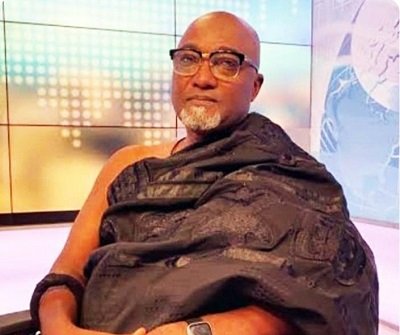
The Writer is a Traditional Ruler in the Eastern Nzema Traditional Area
BY NANA ANNOR AMIHERE II
You can now read the *Ghanaian Times* and *The Spectator* newspapers digitally on [TimesNewsPlus](https://timesnewsplus.com/newspapers).
Follow our WhatsApp Channel now! https://whatsapp.com/channel/0029VbAjG7g3gvWajUAEX12Q