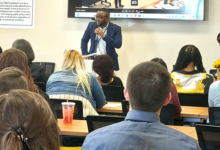
At 3i Africa Summit 2026: Fidelity Bank pushes for Africa-led digital infrastructure

Fidelity Bank Ghana has reinforced its position as a key voice in Africa’s digital transformation agenda following its participation in the 3i Africa Summit 2026, where Bank executives joined high-level conversations on digital infrastructure, fintech innovation, and the future of Africa’s digital economy.
As sponsors of the summit, Fidelity Bank participated in strategic discussions that brought together policymakers, financial institutions, fintech leaders, regulators, and ecosystem players focused on accelerating innovation and inclusive growth across the continent.
A major theme that emerged from the Bank’s participation was the urgent need for Africa to build and retain value from its own digital infrastructure.
Speaking during a panel on ‘Digital Public Infrastructure: Building Africa’s Foundations in a Platform-Driven World,’ Director, Financial Institutions Group, Adeline Aryee, called for a stronger focus on African-owned digital rails and payment systems.


“If we build our own rails, it goes without saying that we will get the value from those rails,” she stated.
Drawing parallels between traditional infrastructure and digital ecosystems, she argued that digital public infrastructure had become a national asset that should be intentionally developed to support economic sovereignty and value retention within Africa.
“Back in the days, when you talked about infrastructure, it was about roads and bridges. Today, it is about digital public infrastructure,” she noted.
Ms Aryee highlighted Ghana’s progress in financial inclusion and digital payments, describing it as a model that can be replicated across the continent.
However, she stressed that the next phase for Africa must move beyond inclusion toward ownership and value creation.
She also questioned why local transactions continue to rely heavily on external payment rails despite the availability of domestic infrastructure such as Gh-link, warning that excessive dependence on foreign systems places unnecessary pressure on African currencies and economies.
“Global tech is good, and we appreciate what global giants have done, but Africa needs to wake up. It is time to create our own rails and retain value on the continent,” she added.
The Bank also contributed to discussions around fintech growth, innovation ecosystems, and digital market expansion.
Speaking during the Ecosystem Roundtable on ‘The Intersection of Platforms, Talent, and Markets in Building Africa’s Digital Economy,’ Head of Mobile Financial Services, Dr Prince Osei Hyeaman-Addai, emphasised the importance of building digital solutions around real market needs rather than assumptions.
“When you start off, you start with the market. The market tells you the pain areas, the problems to solve, and even the kind of platform you should build.”
Drawing from Fidelity Bank’s experience in digital financial services and mobile money partnerships over the years, he noted that successful innovation requires deep understanding of customer behaviour, trust, and local realities.
He further stressed that sustainable innovation depends on continuous engagement with users.
“The voice of the customer is critical. Even when you need to scale back or improve a product, you must return to the market and ask what you got wrong,” he added.
Beyond technology, Prince also highlighted the importance of trust, structure, and credibility in attracting investment into African fintech ecosystems.
According to him, while funding opportunities exist, startups and innovators must demonstrate viability, honesty, and long-term thinking.
He also reflected on Fidelity Bank’s long-standing approach to partnership-led innovation, referencing collaborations with fintech players such as IT Consortium and others that helped pioneer wallet-to-bank integrations and digital financial solutions in Ghana.
BY TIMES REPORTER
Follow our WhatsApp Channel now! https://whatsapp.com/channel/0029VbAjG7g3gvWajUAEX12Q