Early BECE candidates face 2-year ban – Education Minister
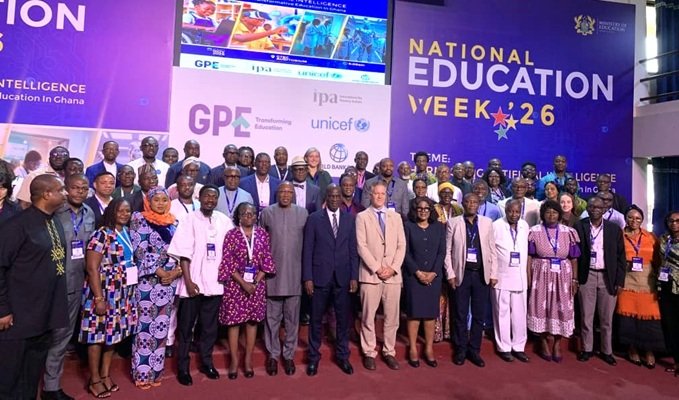
THE Minister of Education, Haruna Iddrisu, has warned that basic school students who sit for the Basic Education Certificate Examination (BECE) before their expected year of completion will face a two-year ban from sitting for the examination.
He said the measure takes effect immediately and seeks to promote discipline, equity and enable education authorities to plan effectively for the examination.
The Minister said some parents compelled their children to advance to Junior High School (JHS 3) and write the examination ahead of their peers, a practice he described as inequitable.
Addressing the 2026 National Education Week and Evidence Summit in Accra yesterday, he explained that the policy would help authorities establish accurate annual figures of candidates expected to complete basic education and sit the BECE.

Speaking on the theme: “Harnessing Artificial Intelligence (AI) for inclusive and transformative education in Ghana,” Mr Iddrisu stated that the government’s ambition was to use AI to improve learning outcomes and develop globally competitive human capital.
He noted that excessive dependence on AI could undermine students’ critical thinking and problem-solving abilities if not used responsibly.
According to him, the government would pursue an equitable and responsible approach to AI adoption while preparing learners for changes in the world of work.
Mr Iddrisu noted that the government was revising the curriculum from kindergarten to Primary Six, with plans to introduce robotics, coding, AI and electronics at the early learning stages.
The Deputy Minister of Education, Dr Clement Apaak, stated that digital innovation and AI were increasingly transforming teaching, learning, assessment and research globally.
Dr Apaak said it was necessary for Ghana to prepare its education system to respond to the changes.
He noted that the government was committed to ensuring that no learner was left behind as the country integrated technology into its education delivery.
Dr Apaak stated that the ultimate objective was to equip every Ghanaian learner with the knowledge, skills and values needed to contribute meaningfully to national development and compete successfully in an increasingly interconnected world.
The Senior Education Specialist and Global EdTech and AI Lead at the World Bank, Dr Ekua Bentil, said Ghana should strengthen its digital education infrastructure and invest in AI skills development to prepare students for the changing demands of the global economy.
She explained that Ghana must move beyond basic digital literacy and equip students with the skills to develop, create and adapt AI technologies rather than merely use them.
Dr Bentil noted that the government needed to prioritise electricity, internet connectivity, digital devices and quality education data as foundations for integrating AI into the education system.
She added that although access to digital technology was important, greater attention must be given to building the capacity of teachers and students to use AI effectively and responsibly.
BY PRINCE ADDO FRIMPONG
SKIP THE QUEUE, TAP THE NEWS

Read the Ghanaian Times and The Spectator newspapers from the comfort of your device via TimesNewsPlus.
Ghanaian Times Subscription
Follow our WhatsApp Channel now! https://whatsapp.com/channel/0029VbAjG7g3gvWajUAEX12Q