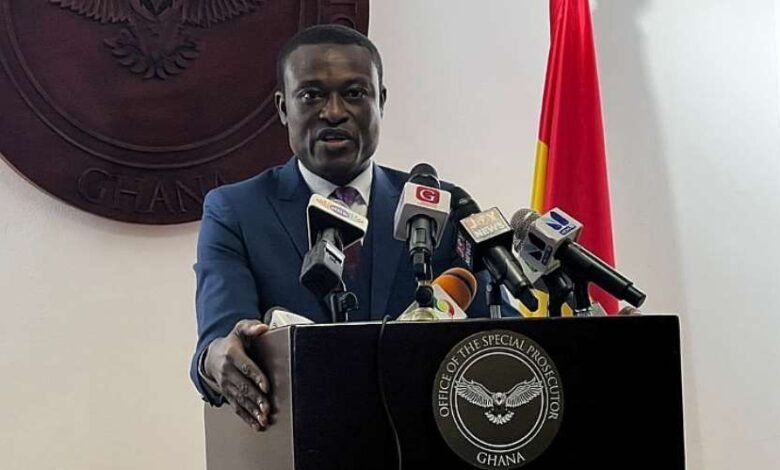
The Office of the Special Prosecutor (OSP) cannot conduct criminal proceedings in court without the express authorisation of the Attorney-General, a High Court in Accra has ruled. Consequently, the court has declared all prosecutions being undertaken by the OSP null and void.
Justice John Eugene Nyadu Nyante made these orders following an action challenging the prosecutorial powers of the OSP. The court has consequently granted a cost of GH¢15,000 against the OSP.
The case is currently before the High Court (Criminal Division), where proceedings remain ongoing. The Criminal Court dismissed an application by the accused seeking to strike out the case. The judge adjourned proceedings to await a determination by the Supreme Court on a matter in which both the plaintiff and the Attorney-General (the defendant) are challenging the independent prosecutorial power of the OSP.
In a parallel development, the accused initiated a separate action at the High Court (General Jurisdiction 10). In contrast to the Criminal Court, the General Jurisdiction judge declined an application by the OSP to adjourn proceedings pending the outcome of the matter before the Supreme Court.

In October 2023, the OSP filed criminal charges against Seidu Issah, an employee of the National Insurance Commission (NIC), and three others for allegedly using fake documents to claim ownership of 10,000 bags of rice imported from Thailand to Ghana. The accused are currently standing trial before the High Court.
The judge decided that the OSP lacks an independent prosecutorial mandate and directed that the case be referred to the Attorney-General for prosecution.
Meanwhile, the OSP has stated that it is taking steps to quickly overturn the decision of the General Jurisdiction Court, arguing that the High Court does not have jurisdiction to strike down parts of an Act of Parliament as unconstitutional. The OSP said it is only the Supreme Court that can strike down parts of an Act of Parliament as unconstitutional.
“The OSP firmly assures the public that all the criminal prosecutions it has commenced before the courts and all the criminal prosecutions it is about to commence before the courts remain valid and would proceed based on its mandate under the Office of the Special Prosecutor Act, 2017 (Act 959), which remains valid and in force as the matter has not been decided by the Supreme Court,” the OSP said in a statement after the High Court ruling.
In a separate case before the Supreme Court, a private legal practitioner, Noah Adamptey, is challenging the constitutionality of the OSP. His counsel, Dr Srem-Sai, contends that because the OSP is a creation of the Legislature, it has no independent proprietary interest in defending the law that birthed it.
A five-member panel of judges who sat on the case ruled that the Office of the Special Prosecutor cannot be a party to a suit challenging its constitutional powers. The court held that the Office of the Attorney-General is the only defendant in the action.
“The OSP has no independent interest in the matter… it is Parliament, as the creator of the office, that must answer for the constitutionality of the law establishing it,” Dr Srem-Sai contended.
On December 10, 2025, the plaintiff filed the suit at the apex court to challenge the constitutionality of Parliament’s decision to establish the Office of the Special Prosecutor (OSP), Deputy Attorney-General Justice Srem-Sai has confirmed.
The OSP attempted to join the Supreme Court case but was unsuccessful. It said it was of the considered view that the legal questions in the case concerning the constitutionality of the Office of the Special Prosecutor Act, 2017 (Act 959), can be fully resolved between the plaintiff and the Attorney-General without the OSP’s direct participation.
BY MALIK SULLEMANA
Follow our WhatsApp Channel now! https://whatsapp.com/channel/0029VbAjG7g3gvWajUAEX12Q