Use AI responsibly …GCTU graduands advised
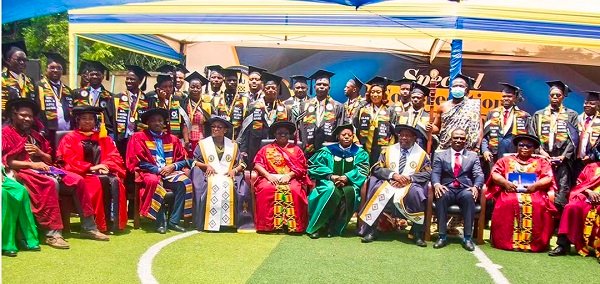
About 300 students graduated from the Ghana Communication Technology University (GCTU) at a special congregation in Accra, with a call on them to become innovators, ethical leaders and lifelong learners to drive Ghana’s digital economy.
The graduands comprised 60 from Coventry University, 132 master’s degree holders and 108 undergraduates from the ICT, Business and Engineering faculties.
They were urged to develop home-grown technological solutions and remain adaptable to the fast-changing demands of the digital age.
The Executive Director of the Data Protection Commission, Dr Arnold Kavaarpuo, who addressed the congregation on Friday, emphasised that graduates were entering a world increasingly shaped by Artificial Intelligence (AI), which continues to transform industries and redefine the future of work.


Speaking on the theme: ‘Shaping the Future: Innovation and Technology Education to Support Ghana’s Digital Economy,’ Dr Kavaarpuo noted that continuous learning and sound judgement had become more critical than ever.
He explained that although AI could generate content, analyse data and automate complex tasks, it could not replace human responsibility or moral judgement.
Dr Kavaarpuo urged the graduates to use AI to enhance their capabilities rather than depend on it entirely, warning that Ghana risked becoming “digitally active without becoming digitally powerful,” if it continued to rely heavily on foreign technologies, infrastructure and digital platforms.
He, therefore, called for increased investment in local innovation, research, intellectual property and digital infrastructure to enable the country to compete globally.
Touching on data governance, he underscored the need for privacy and accountability in the digital economy, indicating that technological advancement must be guided by fairness, trust and respect for human dignity.
He added that the Data Protection Act, 2012 (Act 843), was designed to promote responsible innovation while safeguarding the rights of individuals.
The Acting Vice-Chancellor of GCTU, Professor Ebenezer Malcolm, congratulated the graduates and described them as the next generation of innovators and technology leaders who would play a key role in Ghana’s digital transformation.
He stated that since attaining full public university status under the Ghana Communication Technology University Act, 2020 (Act 1022), the institution had strengthened its position in ICT and technology education.
This, he emphasised, had been achieved through the introduction of new PhD, master’s, bachelor’s and diploma programmes tailored to meet the evolving needs of the digital economy.
Professor Malcolm further noted that the university had expanded partnerships with local and international institutions to provide industry-relevant training, research opportunities and global exposure for students.
He added that investments had also been made in modern lecture halls, office complexes and hostel facilities to enhance teaching and learning.
According to him, the university remained committed to producing graduates equipped with skills in artificial intelligence, cybersecurity, cloud computing, robotics, data science, financial technology and smart manufacturing.
He urged the graduates to uphold professionalism, integrity and excellence, reminding them that graduation marked the beginning of a lifelong journey of learning, innovation and service to national development.
Moreover, Professor Malcolm expressed confidence that the graduates would become worthy ambassadors of the university and contribute meaningfully to Ghana’s technological advancement.
BY STEPHANIE BIRIKORANG