Africa must look within domestic economy for development financing … as Aid dwindles – IMF
African countries must increasingly rely on their own resources and institutions to drive development as international aid continues to decline, the International Monetary Fund (IMF) has advised.
According to the IMF, the era of predictable and abundant foreign aid was gradually fading, making it imperative for governments across the continent to strengthen domestic revenue mobilisation, improve public spending, and build resilient institutions capable of sustaining growth and essential services.
The call was made in the IMF’s latest report, “Aid Is Falling Fast. What Can African Countries Do?,” which examined developments in 28 African countries.
The report was authored by economists Chie Aoyagi, Maurizio Leonardi and Athene Laws of the IMF’s African Department, together with research analyst Hamza Mighri.

The report noted that official development assistance had, for decades, been a key source of financing for many countries in sub-Saharan Africa. However, that support is now shrinking rapidly.
It revealed that bilateral aid to the region declined sharply in 2025, with preliminary estimates indicating a reduction of about 26 per cent within a single year.
The IMF stressed that the situation was particularly worrying because many African countries have limited fiscal space and few alternative sources of financing.
“With aid less predictable, resilience increasingly depends on domestic institutions. This means mobilising more revenue, improving spending efficiency, and strengthening policy design and service delivery,” the report stated.
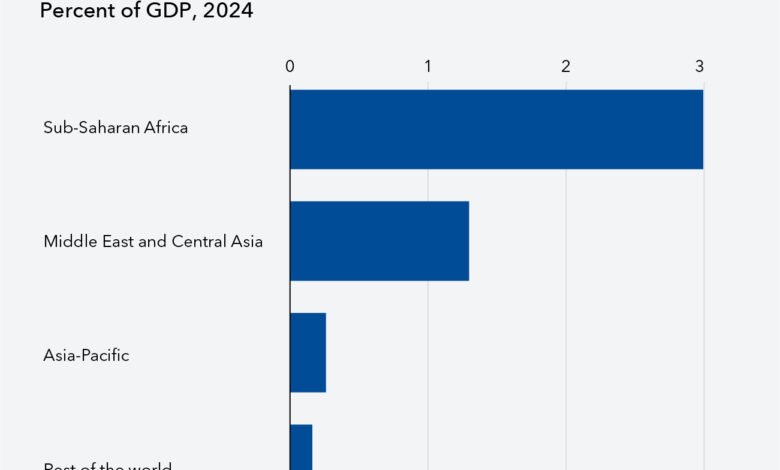
Sub-Saharan Africa remains the most aid-dependent region in the world. While aid accounted for an average of three per cent of gross domestic product (GDP) across the region in 2024, the figure was significantly higher in low-income and fragile states, where it often exceeded six per cent of GDP.
More than half of the aid received by these countries was directed towards critical sectors such as health, education and humanitarian assistance.
The IMF warned that reductions in aid could therefore undermine essential services and weaken systems that millions of vulnerable people depend on.
The report indicated that aid-supported interventions had been crucial in responding to health emergencies, conflicts and climate-related crises across the continent, including Ebola outbreaks and droughts in the Horn of Africa.
The IMF acknowledged that each option comes with significant trade-offs.
While replacing lost aid through borrowing or increased spending may help preserve essential services, it could also widen fiscal deficits and increase debt burdens. Conversely, failing to replace the funding may protect public finances but risk long-term setbacks in human development.
To navigate the changing landscape, the Fund urged policymakers to focus on three priorities: protecting high-impact aid, expanding financing options through instruments such as blended finance, and strengthening domestic institutions.
The report concluded that the decline in aid marked a major turning point for Africa’s development financing framework and that countries would need to adapt to a future in which external support is less certain and domestic policy choices play a much larger role in shaping development outcomes.
Photo Caption: Sub-Saharan Africa has the highest aid dependency globally.
BY KINGSLEY ASARE
Follow our WhatsApp Channel now! https://whatsapp.com/channel/0029VbAjG7g3gvWajUAEX12Q