NCCE urges students to fight corruption
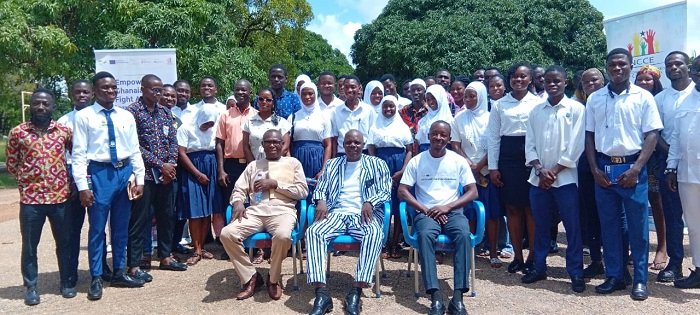
The National Commission for Civic Education (NCCE) has urged student groups in Wa of the Upper West Region to promote accountability, uphold the rule of law and reject corruption.
The call was made during a youth dialogue organised by the NCCE, with support from the Netherlands Development Organisation (SNV) and other partners.
The engagement brought together student leaders and youth groups to deepen their understanding of good governance, corruption, accountability and the rule of law.
The programme formed part of the commission’s constitutional mandate to educate citizens on their rights and responsibilities, and to encourage public participation in governance.


It featured presentations by officials of the NCCE and the Commission on Human Rights and Administrative Justice (CHRAJ), alongside interactive sessions with students drawn from groups such as the Graduate Students’ Association of Ghana (GRASAG), the Tertiary Students Confederacy (TESCON) and other associations.
The discussions focused on equipping participants with knowledge on conflict of interest, ethical leadership, transparency and the role of citizens in demanding accountability from public institutions.
Addressing the participants, the Deputy Upper West Regional Director of the NCCE, John Yibile, described corruption as a major obstacle to Ghana’s political, social and economic development.
He said corruption weakened democratic governance, undermined the rule of law and deprived future generations of opportunities.
Mr Yibile noted that corruption discouraged investment and slowed national development, adding that legal and policy measures alone had not been sufficient to eliminate the problem.
He cited Article 233 of the 1992 Constitution, which mandates the NCCE to educate citizens on their rights and obligations, and Article 41, which outlines the responsibilities of citizens.
According to him, sustained public demand for accountability remained critical in addressing corruption.
He said the commission continued to organise civic engagements, social audits, democracy lectures and dialogue series to strengthen citizen participation in governance and oversight.
Mr Yibile added that the NCCE engaged civic education clubs in senior high schools and tertiary institutions, as well as youth groups, women’s organisations and faith-based institutions, to promote active citizenship.
He explained that civic education helped transform citizens from passive observers into active participants in national development by enhancing their understanding of accountability mechanisms and democratic governance.
Mr Yibile stressed that good governance went beyond the provision of development projects and public services, and required transparency, accountability, inclusiveness and strict adherence to the rule of law.
In an interview, the Chief Investigator of CHRAJ in the Upper West Region, Sebastian Ziem, said the dialogue sought to bridge knowledge gaps on conflict of interest, public office responsibilities and the rule of law.
A participant, Saeed Nusrat, a student of Nusrat Jahan College of Education, said the programme had improved her understanding of citizens’ rights and responsibilities.
FROM NAZIRU ALHASSAN, WA
Follow our WhatsApp Channel now! https://whatsapp.com/channel/0029VbAjG7g3gvWajUAEX12Q