What Has Ghana’s Big Push and Sovereignty Laws Got to Do With an Ivorian Named Hassan Dakhlallah?
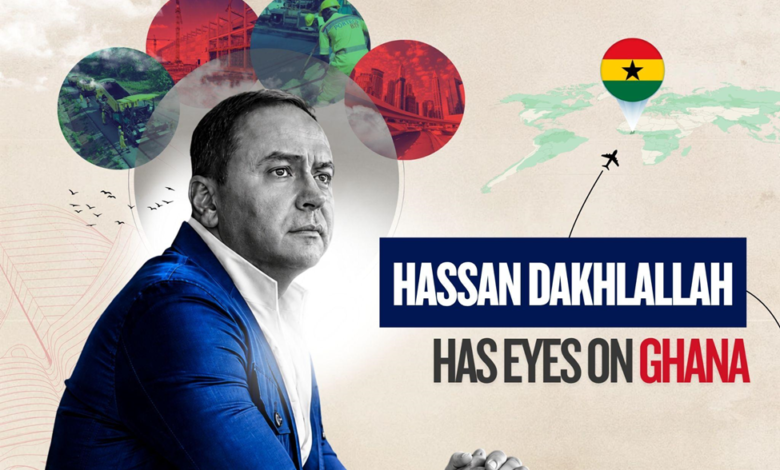
From a $10 billion road programme to a law that its data must live at home, Ghana is betting its future on execution. At the same time, an Ivorian who made that same bet a philosophy, in asphalt and in server racks, is arriving in Accra.
Hassan Dakhlallah, Founder and CEO, Porteo


On 24 April 2026, launching Ghana’s first National Artificial Intelligence Strategy in Accra, President John Mahama said the country would no longer be a passive consumer of the technologies reshaping the world. A month earlier the Bank of Ghana had published something with sharper teeth. Its Cyber and Information Security Directive, analysts noted, states that sensitive financial data must be stored within Ghana, an enforceable sovereignty requirement reaching banks, fintechs and the widening circle of vendors now designated critical information infrastructure.
Read together, these are the acts of a country that has decided its most valuable assets, its data, its compute, its roads, its trade, should be built and held at home rather than rented from abroad.
Sovereignty is a fashionable word in Accra this year. It is also an enormously physical one. A sovereign AI needs a sovereign data centre to run on; a localisation law needs hardened buildings of audited servers on national soil. None of it moves without someone who can build the thing, on time, to a standard a central-bank examiner will sign.
Ghana has the ambition written down. What every version of it waits on is execution.
Three thousand kilometres west, in Abidjan, a man has spent fifteen years arguing that execution is the whole ballgame, and building a company to prove it. He is not Ghanaian, and until recently was barely known in English-speaking Africa. His name is Hassan Dakhlallah, and Ghana is one of the first anglophone markets he means to enter.
A Thesis, Not a Contractor
It is tempting to file Dakhlallah as a road builder looking for new markets. That undersells what he represents, and misreads why he matters to Ghana.
His firm, PORTEO Group, founded in Côte d’Ivoire in 2011 and renamed from NSE.CI in 2020, is now organised around eight divisions running from infrastructure and construction through industry, real estate, agro-industry and, tellingly, the digital sector. It operates in seven countries, employs some 12,000 people of twenty-three nationalities, and has delivered more than 3,000 kilometres of road. The French press, which tracks him closely, ranks it 342nd among Africa’s 500 largest companies and calls the group “a laboratory of African sovereignty in action.”
That phrase is the key to him. Dakhlallah does not talk like a contractor but like a man with a single thesis: that sovereignty is not a document a government signs but a capacity a country builds. He has published tribunes under his own name to that effect, titled “AfCFTA will not be decreed; it will be built, corridor by corridor” and “a pan-African group becomes credible when its standards travel with it.” At the Africa CEO Forum in Abidjan he compressed it: sovereignty is built on concrete, not slogans.
The machine underneath is vertical integration taken further than almost anyone in African construction. PORTEO makes its own concrete at Technic Béton, rolls its own steel at B. Steel, produces its own asphalt and aggregates, owns upwards of 3,000 machines outright, and trains its own engineers, so that on any site it depends on no outside chain it cannot control. “Productive sovereignty is not decreed,” he told Fraternité Matin. “It is built patiently, by giving yourself the means not to depend, on every single site, on an outside chain.” It is not a cheap way to build. It is a durable one, and durability is exactly what Ghana keeps saying it cannot buy.
The Same Conviction, Poured Two Ways
Here roads and data centres stop being two businesses and become one argument.
Start with the roads, where the thesis was proven. PORTEO is paving 300 kilometres of the Transgabonaise in Gabon, the last unsurfaced stretch between Libreville and Franceville, a €213 million contract that Forbes Afrique reports is the longest ever entrusted to a single company there, carrying 1,500 local jobs and more than sixty local firms, with concrete, bitumen and aggregate units built beside the works.
The African Development Bank named him Builder of the Year in 2024; Côte d’Ivoire has given him its National Excellence Award three times. The point of the roads, in his telling, is never the asphalt. It is that a road connects a territory, carries trade, and lets an economy exist where before there was only a plan.
Now the servers, the same idea in a harder material. PORTEO is one of very few African contractors to have built a sovereign national data centre, the high-security facility that lets a state host its own critical data on its own soil. It has done it twice. In Abidjan it built Côte d’Ivoire’s national data centre, a Tier III+ facility for the country’s administrative data, with the American cybersecurity firm Cybastion; the roughly $60 million project was backed by the US Export-Import Bank, which in May 2026 named it its Industries of the Future Deal of the Year.
Near Libreville it is building the first sovereign data centre in Central Africa, foundation stone laid March 2025 after an agreement struck at a US-Gabon roundtable in Washington, to keep the Gabonese state’s strategic data inside Gabon and train more than a thousand young Gabonese to run it.
The statistic explaining why both governments bothered should concentrate minds in Accra: roughly 95 percent of Africa’s data is hosted off the continent, on servers no African government owns or controls.
A road built by foreign hands and a database held on a foreign continent are, to Dakhlallah, the same dependence and the same thing to fix. It is why the man who owns a quarry in Côte d’Ivoire also poured the foundations of a Tier III+ server hall next door. One conviction, expressed twice.
Why This Meets Ghana at Exactly the Right Moment
Ghana is not shopping for basics, which is what makes the timing pointed. It is unusually far along, and that maturity has turned sovereignty from slogan into engineering problem.
Internet penetration runs around 70 percent, close to South Africa’s and far above the continental average; Accra is landed by six submarine cables; the Ghana Card and Digital Address System already give the country working identity and addressing systems at scale.
On the roads side, the $10 billion Big Push is rebuilding infrastructure across all sixteen regions, its Wenchi to Wa road split into seven lots for speed. On the digital side sit an AI strategy, a $250 million compute centre, a localisation directive and a sovereign chatbot.
Both agendas, the tarmac and the terabytes, hit the identical wall once the ceremony ends. Ghana’s own chief quantity surveyor at the roads ministry, Surv. Dr. Emmanuel Norgah Bukari, wrote in April that the Big Push’s economics are sound and that what has never been solved are the institutional, financial and human problems that wrecked every programme before it.
Swap “road” for “data centre” and the sentence holds. You can legislate localisation in an afternoon; building the audited estate that satisfies it is the unglamorous thing PORTEO has spent fifteen years and two data centres learning to do on deadline.
The Honest Ledger
None of this is a reason to wave a foreign builder through. Dakhlallah has never delivered anything in Ghana, and in a country whose citizens are footing the bill, an outsider with no local record is a fair thing to question; local partnership, jobs and ownership should be pressed hard. His data-centre work leans on an American consortium, a strength on financing and a legitimate question for a country weighing whose technology sits inside its sovereign estate. Roads still supply close to ninety percent of revenue, a concentration the company itself calls excessive and aims to halve by 2030 through the sectors Ghana is prioritising: data centres, water, agro-industry.
Against that stands a record rather than a promise. Three thousand kilometres of road. A port won in Tanzania. Two sovereign data centres, one a US EXIM deal of the year. An ISO triple certification renewed on a three-year audit cycle. And, on the record, advanced discussions with Ghana about a Big Push road, the door he is walking through, even if the more interesting room, given what the Bank of Ghana has just mandated, is the one down the hall.
What He Actually Believes, and Why It Fits
Strip away the projects and Dakhlallah’s argument is almost austere. Africa, he says, has never lacked visions; ministries are full of decade-long plans and continental agendas. What it has lacked is executants who can turn a signed plan into a finished thing on the day they promised.
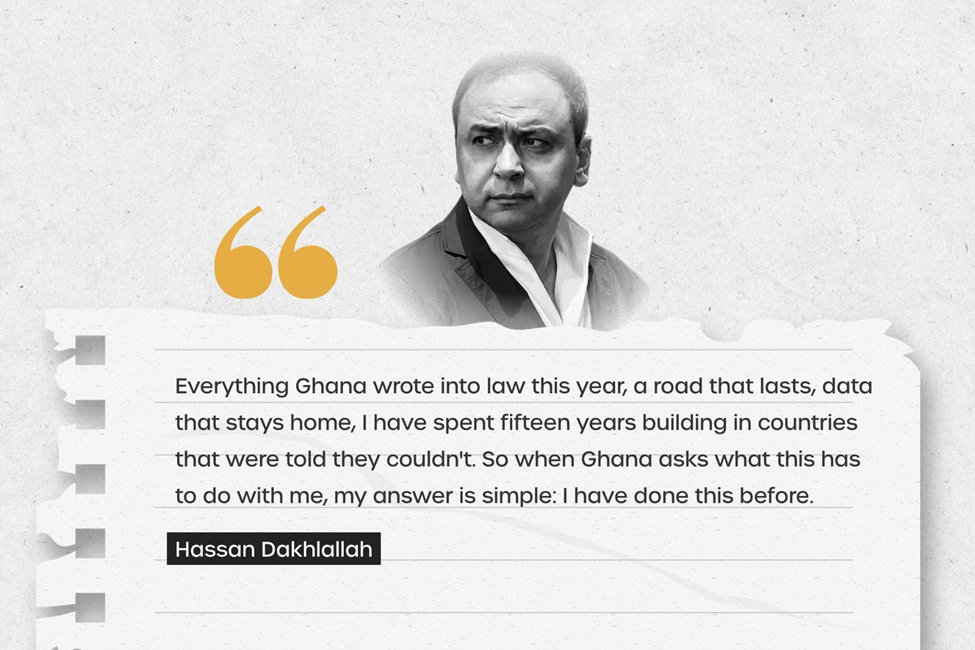
“We are moving from a time when we debated priorities,” runs the line he repeats across interviews, “to a time when we measure capacities.” A public plan, he insists, is worth nothing until it meets someone able to make it real.
It is, whether or not he says the name, the argument of some of the continent’s founding fathers, that political independence without productive capacity is a flag and an anthem and little else, now written in server racks as well as rebar, by a group whose chief executive is Senegalese and whose payroll spans twenty-three African nationalities.
And it carries a social clause he treats as structural: a road that does not reach a school or a clinic, he has said, is unfinished. The PORTEO Foundation, which he runs with his wife, funds surgeries, renovates rural classrooms for thousands of pupils and backs women’s cooperatives, on the logic that infrastructure only counts when it changes an ordinary day.
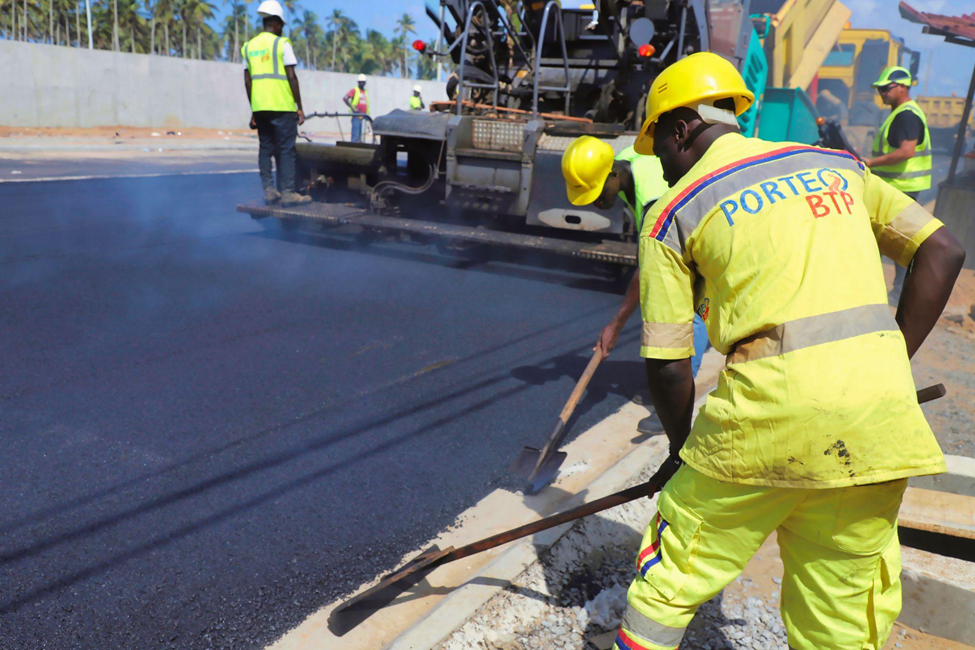
Ghana spent 2026 deciding, in law and in strategy, that its roads, its data and its future should be built and held at home. The things that make those decisions real, the audited server halls and the roads that open on schedule, do not exist yet, and they are hard to build. The man now turning up in Accra has spent fifteen years turning that exact conviction into concrete, on time, in country after country that had never done it before.
The word Ghana chose this year was sovereignty. Hassan Dakhlallah has been spelling it, kilometre by kilometre and server by server, for a decade and a half.