159 medical students of SMS-UCC inducted into clinical training
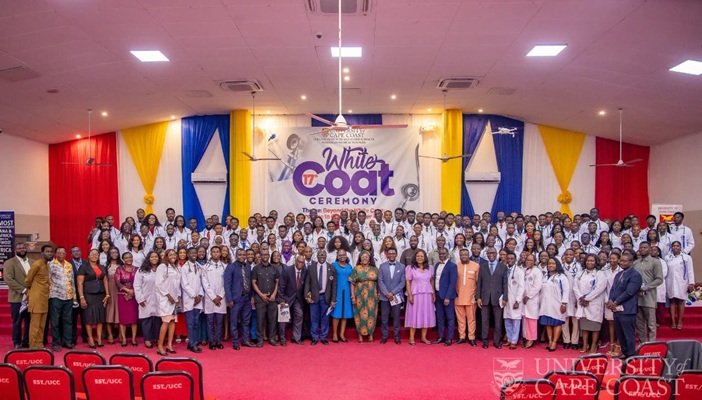
THE School of Medical Sciences of the University of Cape Coast (SMS-UCC) has inducted its 159 medical students into the clinical phase of their training, with a call on them to prioritise their training and adhere to the ethics of the medical profession.
The Dean of the School of Medical Sciences, UCC, Prof. Patrick Kafui Akakpo, who made the call, reminded the new clinical students that professionalism, empathy and accountability must begin on the very first day of clinical training.
Held on the theme: ‘Beyond the White Coat: A Promise to Ghana and Her People’, it marked the transition of the students from pre-medical training to clinical education, where they will apply their knowledge and skills in caring for patients on the wards and in the operating theatres.
Prof. Akakpo said the students must not enter the wards with knowledge alone, but with identity, responsibility and compassion. He urged the students to prioritise patients’ lives while cautioning them to avoid using their phones during working hours.

He also argued that medical education cannot be separated from human beings while explaining that the practice of medicine is learned from people, especially patients who allow students to examine, question and learn through their lived experiences.
He warned that privilege comes with responsibility, and used a recent national tragedy as a lesson to drive home the consequences of neglect.
He stated that indifference from medical practitioners can cost lives, whether the neglect is deliberate or hidden behind distractions.
On the courses at the UCC SMS, Prof. Akakpo explained that the curriculum is built on a fully integrated problem-based learning model designed to ensure students learn through enquiry, teamwork and real-world problem-solving.
According to him, the medical students are immersed in rural and peri-urban communities to understand the social determinants of health at the community level.
The SMS-UCC, he said, would modernise teaching and embrace new technologies, including artificial intelligence, but warned that machines may help, but cannot replace the human qualities required in medicine.
In an address, physician and healthcare leader, Dr Philip Anderson, urged the students to always reflect on the tenets of the white coat in terms of discipline, humility and service, explaining that it symbolises not status, but accountability.
He charged them to look beyond the symbolic significance of the white coat and recognise the duty associated with the medical profession.
He further admonished them to uphold the highest standards of professionalism, integrity, compassion and service as they continued their training and prepared to contribute meaningfully to Ghana’s healthcare system and beyond.
Dr Anderson further underscored the changing trends within the medical profession, explaining that medicine is no longer simply a matter of lecture halls, textbooks and anatomy tables.
The Provost of the College of Health and Allied Sciences, Prof. Dorcas Obiri-Yeboah, for her part, urged the students to refrain from any form of discrimination against patients during their clinical training.
She also indicated the need for them to ensure the protection of the rights of patients at all times, particularly their right to privacy.
The students, who had completed their pre-medical training, were robed in white coats and presented with stethoscopes to symbolise their entry into clinical training.
FROM DAVID O. YARBOI TETTEH, CAPE COAST
You can now read the *Ghanaian Times* and *The Spectator* newspapers digitally on [TimesNewsPlus](https://timesnewsplus.com/newspapers).
Follow our WhatsApp Channel now! https://whatsapp.com/channel/0029VbAjG7g3gvWajUAEX12Q