The government must urgently develop a clear strategy to mobilise more revenue from the small-scale gold mining sector, the Institute of Fiscal Studies (IFS) has said.
The Institute said although small-scale mining was making an increasingly significant contribution to Ghana’s gold exports, the sector was not generating commensurate fiscal returns for the country.
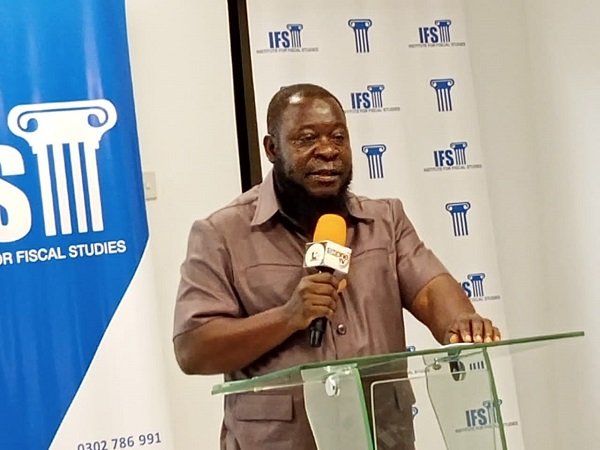
The Executive Director of the IFS, Dr Said Boakye, made the call when he presented the Institute’s assessment of the 2026 Mid-Year Budget Review and Economic Policy of the government.
He said recent developments in the gold industry, particularly the implementation of the Domestic Gold Purchase Programme and the establishment of the Gold Board, had highlighted the enormous revenue potential of the small-scale mining sector.


According to the IFS, Ghana’s gold exports more than doubled in 2025, rising by 103.3 per cent from $10.31 billion in 2024 to $20.98 billion.
Small-scale miners accounted for $10.8 billion, representing 51.5 per cent of total gold exports, Dr Boakye said.
He, however, noted that mineral royalties increased by only 21 per cent, from $364 million in 2024 to $441 million in 2025.
Information from the Minerals Income Investment Fund, he said, indicated that the royalties collected from gold production in 2025 came entirely from the large-scale mining sector.
Dr Boakye said the figures demonstrated a major weakness in Ghana’s mining fiscal regime, with corporate income tax and other revenue instruments also yielding little or nothing from the small-scale mining sector.
He said the government could no longer afford to allow the situation to continue, particularly at a time when the country was under pressure to raise domestic revenue and meet its financing obligations.
The IFS, however, acknowledged some positive developments in the economy during the first half of 2026.
It noted that inflation remained relatively low despite recent increases, while interest rates continued to decline significantly.
The 91-day Treasury Bill rate, for instance, fell to 5.7 per cent in June 2026, from 28 per cent in December 2024, while the average lending rate declined to 15.6 per cent from 30.3 per cent over the same period.
The Institute also welcomed the government’s decision to extend its new commitment authorisation system to State-Owned Enterprises (SOEs), describing the move as appropriate given the contribution of poorly performing SOEs to Ghana’s debt challenges.
Despite the gains, the IFS said the execution of the 2026 budget had been poor.
It said total expenditure in the first half of 2026 fell short of the budgeted amount by GH¢35.6 billion, representing 20.6 per cent, while capital expenditure recorded a shortfall of GH¢14.35 billion.
Arrears payments also fell short by GH¢8.64 billion, or 61.8 per cent, a situation the Institute warned could constrain economic activity and growth.
The IFS further raised concerns about what it described as unrealistic revenue and Gross Domestic Product (GDP) projections, as well as inconsistencies in the budget documents.
It therefore urged the government to improve budget execution, align spending with approved plans and, most importantly, put in place effective mechanisms to capture significant revenues from the small-scale gold mining sector.
BY KINGSLEY ASARE
Follow our WhatsApp Channel now! https://whatsapp.com/channel/0029VbAjG7g3gvWajUAEX12Q