Mining industry must rethink talent development – Telecel Ghana, CEO
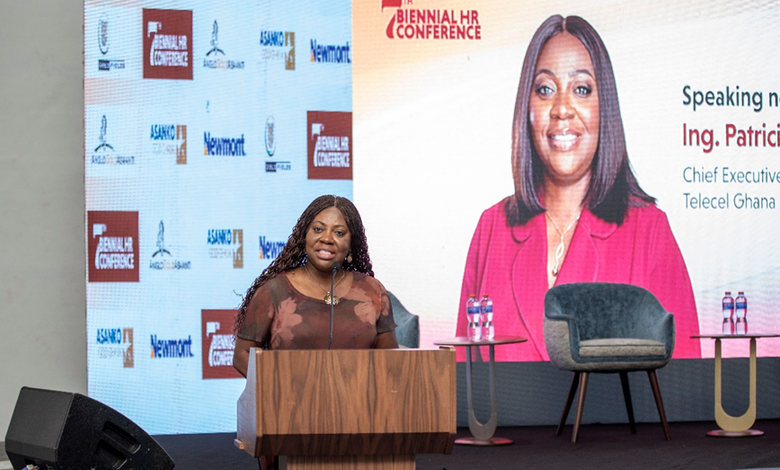
The Chief Executive Officer (CEO) of Telecel Ghana, Ing. Patricia Obo-Nai, has challenged Ghana’s mining industry to rethink its approach to talent development, saying its ability to harness Artificial Intelligence (AI) and other emerging technologies will depend largely on how quickly its workforce acquires new skills.
“Technology has never transformed an organisation on its own. It is people who transform organisations using technology.”
“Rather than hiring people simply for today’s vacancies, organisations must recruit for adaptability, curiosity and learning agility,” she said.
Ing. Obo-Nai was delivering the keynote address as the Special Guest of Honour at the seventh Biennial Human Resource Conference of the Ghana Chamber of Mines in Accra.


The conference, held at The Palms by Eagles, was on the theme: ‘Future-Ready People: Building the Workforce for Ghana’s Next Era of Mining.’
She identified three priorities for building a workforce capable of meeting the demands of the future: developing agile capabilities, making continuous learning part of everyday work and harnessing diversity to drive innovation.
The conference brought together mining industry leaders, human resource professionals and other stakeholders to discuss how the sector could develop the skills and leadership needed to sustain its next phase of growth.
Drawing on the experience of the telecommunications industry, where technology and customer expectations have changed rapidly over the past decade, Ing. Obo-Nai indicated that organisations that succeeded in a changing environment would be those that learned faster than the pace of change.
She noted that employees needed continuous opportunities to acquire new knowledge and skills, and that learning should be integrated into their daily work.
For the mining industry, she emphasised, that meant preparing employees before their skills became outdated instead of waiting for technological changes to expose capability gaps.
“We can no longer afford to wait until employees become digitally obsolete before investing in their development. When automation changes operational processes, employees cannot simply attend a workshop once every year. They require continuous access to new knowledge, which means organisations must rethink about learning and development differently,” she explained.
Ing. Obo-Nai also urged mining companies to intensify efforts to attract and retain women in engineering, technology and other technical fields.
She said organisations risked losing valuable ideas and perspectives when talented women could not see clear pathways into technical careers or were not adequately represented in such industries.
She cited Telecel’s Female Engineering Students Scholarship Programme, which provides female engineering students with financial assistance, laptops, data, mentorship and internship opportunities.
She also mentioned the company’s DigiTech Academy, which introduces young people to practical Science, Technology, Engineering and Mathematics (STEM) skills, including robotics, web design and app development.
Opening the conference, the CEO of the Ghana Chamber of Mines, Ing. Dr Kenneth Ashigbey, said Ghana’s mining industry had significant human potential and capacity but needed to be more deliberate about developing the capabilities required for the future.
He called for stronger collaboration between academia and industry to enable research, knowledge and talent to move more freely between the two sectors.
He described the workplace of the future as one in which people had the psychological space to experiment, learn and innovate, saying the “mine of the future must be a classroom.”
BY TIMES REPORTER
You can now read the *Ghanaian Times* and *The Spectator* newspapers digitally on [TimesNewsPlus](https://timesnewsplus.com/newspapers).
Follow our WhatsApp Channel now! https://whatsapp.com/channel/0029VbAjG7g3gvWajUAEX12Q