Services lead Ghana’s economic growth to 6.5% in June – GSS
Ghana’s economic activity expanded by 6.5 per cent in June 2026, up from 6.0 per cent in May, driven largely by strong growth in the services sector, the Ghana Statistical Service (GSS) has reported.
The latest Monthly Indicator of Economic Growth (MIEG) shows that the economy’s index rose to 116.7 in June 2026, from 109.6 recorded in June 2025.
The Government Statistician, Dr Alhassan Iddrisu, who released the figures, said the latest performance reflected increased activity across the three major sectors of the economy.
The MIEG is a monthly volume index designed to track movements in economic activity and provide an early signal of developments in the economy.
Unlike quarterly GDP figures, the indicator is produced from monthly volume indicators and administrative records covering economic activities contained in the quarterly GDP system.
“Ghana’s economy recorded a yearly growth rate of 6.5 per cent in June 2026,” Dr Iddrisu said, adding that the figures were provisional and could be revised as more comprehensive data become available.
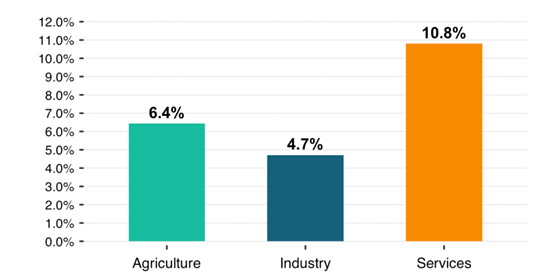
The services sector was the biggest driver of the expansion, growing by 10.8 per cent over the period under review, he said, adding that the sector alone accounted for 54.3 per cent of overall economic growth, with the Information and Communication sub-sector identified as the main source of the expansion.
Dr Iddrisu said industry also recorded growth, expanding by 4.7 per cent between June 2025 and June 2026. According to the GSS, the improvement was largely supported by increased activity in the manufacturing sub-sector.
He said agriculture, meanwhile, grew by 6.4 per cent, supported mainly by the crops and livestock sub-sectors.
In terms of contribution to overall growth, the Government Statistician said industry accounted for 29 per cent, while agriculture contributed 14 per cent.
The June performance provides an early indication of economic activity ahead of the release of quarterly Gross Domestic Product (GDP) figures.
The GSS said the indicators are adjusted for the effects of inflation using monthly Consumer Price Index (CPI) and Producer Price Index (PPI) data.
It explained that the methodology is designed to ensure that MIEG growth rates are aligned, as far as possible, with the quarterly GDP estimates.
However, the Service cautioned that the MIEG remains an experimental statistic and is subject to continuous improvement and revision.
“The MIEG is subject to the same revisions policy as the quarterly and annual national accounts,” the GSS said, noting that revisions could occur for up to two years as additional data become available and the monthly estimates are reconciled with quarterly and annual national accounts.
The June MIEG is also not seasonally adjusted, meaning month-on-month growth rates are not published because factors such as public holidays could distort monthly comparisons.
The GSS said seasonal adjustments would be introduced once a sufficiently long time series is available.
By KINGSLEY ASARE
You can now read the *Ghanaian Times* and *The Spectator* newspapers digitally on [TimesNewsPlus](https://timesnewsplus.com/newspapers).
Follow our WhatsApp Channel now! https://whatsapp.com/channel/0029VbAjG7g3gvWajUAEX12Q