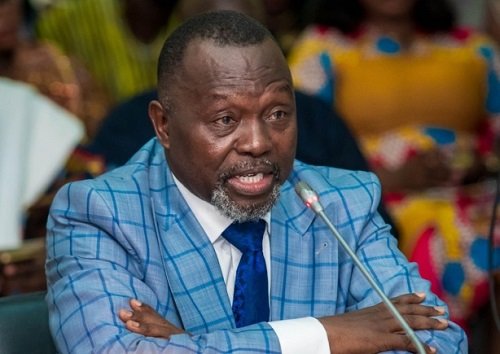
Parliament last Thursday passed the Tribunals Bill, 2026, despite a walk-out by the Minority Caucus, which strongly opposed the legislation.
The bill seeks to address gaps in the country’s legal framework on tribunals by providing a clear constitutional and statutory basis for their operation within Ghana’s democratic system.
It is also intended to remove the historical stigma associated with public tribunals and promote the efficient administration of justice.
The more than 50-clause bill was laid before Parliament on June 26, 2026, by the Minister of Lands and Natural Resources, Mr Emmanuel Armah-Kofi Buah, on behalf of the Attorney-General and Minister of Justice, Dr Dominic Ayine.

It was subsequently referred to the Constitutional and Legal Affairs Committee for consideration before returning to the House for approval.
The bill was passed after Dr Ayine moved the motion for its third reading.
Ahead of its passage, the Minority Leader, Mr Alexander Afenyo-Markin, urged the House to delete Clause 4, which provides for the establishment of Regional and District Tribunals.
He argued that there was no justification for creating additional judicial structures when the existing court system was functioning effectively.
Although Articles 125 and 126 of the Constitution recognised the possibility of establishing tribunals, he said Parliament was not under any obligation to do so.
Mr Afenyo-Markin maintained that Ghana’s current judicial architecture — comprising the district, circuit and high courts, as well as the Court of Appeal was not broken and did not require a parallel system.
However, the Majority members rejected the proposal, insisting that the bill would strengthen the justice delivery system without reviving concerns associated with past public tribunals.
The First Deputy Speaker, Mr Bernard Ahiafor, who presided over proceedings, put the proposal to a voice vote, which was rejected.
Dissatisfied with the outcome, Mr Afenyo-Markin challenged the decision, prompting the Majority Leader, Mr Mahama Ayariga, to suspend proceedings for several hours to allow for consultations among leadership.
When the House resumed, a headcount was conducted at the request of the Minority Leader, and the proposal to delete Clause 4 was defeated by 135 votes to 16.
Following the vote, Mr Afenyo-Markin announced that the Minority would withdraw from further consideration of the bill, arguing that it sought to create what he described as a parallel system not contemplated by the Constitution.
The Minority Caucus subsequently walked out of the chamber.
Speaking to journalists after the walk-out, Mr Afenyo-Markin said the Minority’s decision was taken because it had become clear that the Majority was unwilling to accommodate opposing views.
He said although Parliament was a forum for debate and consensus-building, the Majority had indicated it would rely on its numerical strength to pass the bill regardless of dissenting opinions.
The bill was subsequently passed by the House.
BY BENJAMIN ARCTON-TETTEY
Follow our WhatsApp Channel now! https://whatsapp.com/channel/0029VbAjG7g3gvWajUAEX12Q