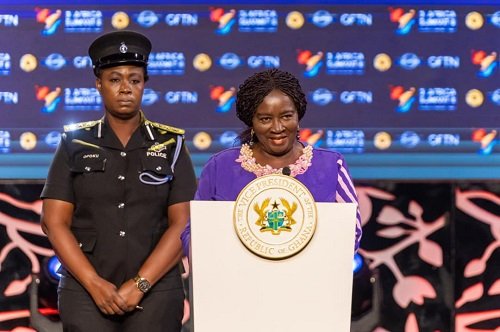
The Vice President, Professor Naana Jane Opoku-Agyemang, has announced that Ghana will collaborate with partners across Africa and beyond to pilot a continental digital trade corridor aimed at boosting cross-border payments, digital identity systems and electronic invoicing across the continent.
She made the announcement at the 2026 3i Africa Summit in Accra yesterday, where she explained that the pilot project would focus on mobile money interoperability, mutual recognition of digital identities for cross-border verification, and harmonised electronic invoicing systems to make trade faster and more affordable within Africa.

According to her, Africa must move from isolated successes in digital finance to scalable systems that work seamlessly across borders.
She stressed that true integration would depend on the effective alignment of payments, identity systems, regulations and infrastructure.


Professor Opoku-Agyemang said Ghana’s role as a gateway to Africa should not remain rhetorical, but must be reflected in how quickly transactions were completed, how easily businesses connect, and how reliably markets function.
She noted that although Africa was often described as a frontier for innovation, the focus should now shift to how countries organise themselves to build competitive and robust systems.
The Vice President also said digital integration was key to economic sovereignty, adding that many African businesses still faced high transaction costs because payments are routed through systems outside the continent and in foreign currencies.
She pointed to initiatives such as the Pan-African Payment and Settlement System as steps in the right direction, but stressed that more work was required to deepen integration.
She further explained that a strong digital economy depends on trusted identity systems, noting that many Africans still lack verifiable digital identities, which limits their ability to trade and access financial services across borders.
The Governor of the Bank of Ghana, Dr Johnson Pandit Asiama, said Africa had made notable progress in financial inclusion, with about 49 per cent of adults in sub-Saharan Africa now using digital financial accounts, according to World Bank data.
He, however, said the current challenge was no longer access, but ensuring that digital finance became more useful through services such as digital credit, supply chain finance and cross-border payment systems.
Dr Asiama explained that the next phase of digital finance would depend on stronger inter-country system linkages, reduced transaction costs and improved regulatory alignment. He added that regulation must both protect users and support innovation.
He outlined ongoing measures by the central bank, including the development of regulations for virtual assets, guidelines for digital credit, promotion of open banking, and support for cross-border fintech operations.
The Chief Executive of the Ghana Interbank Payment and Settlement Systems (GhIPSS), Ms Clara B. Arthur, said Ghana had built a strong payment ecosystem through collaboration among banks, telecom operators and regulators.
She said systems such as mobile money interoperability and instant payment platforms had improved financial access and reduced transaction delays, making digital payments widely used even in local markets.
Ms Arthur added that GhIPSS was upgrading Ghana’s payment infrastructure to meet global standards and was prepared to connect with other African systems to facilitate cross-border transactions.
BY AGNES OPOKU SARPONG
Follow our WhatsApp Channel now! https://whatsapp.com/channel/0029VbAjG7g3gvWajUAEX12Q