Local languages key to fighting disinformation – Report
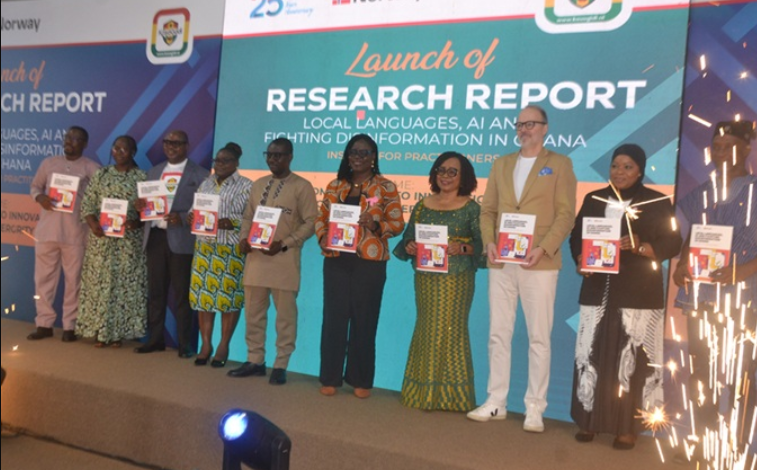
A NEW report on disinformation in Ghana has urged the government, media organisations and researchers to prioritise local languages in developing artificial intelligence (AI) tools and fact-checking systems to curb the spread of false information.
The report, titled Local Languages, AI and Fighting Disinformation in Ghana: Insights for Practitioners, was launched last Thursday on the theme, “From Evidence to Innovation for Information Integrity in Ghana”, as part of activities marking the 25th anniversary of Penplusbytes.
Penplusbytes coordinated the research under the Ghana Anti-Disinformation Coalition Project, with support from the Government of Norway.
Based on a nationwide survey of 469 respondents, the study examined how language and AI influenced the creation, spread and detection of misleading information.


Launching the report, the Minister of State in charge of Government Communications and Presidential Spokesperson, Felix Kwakye Ofosu, whose speech was read by the Deputy Presidential Spokesperson, Shamima Muslim, said the findings exposed a mismatch between the languages Ghanaians used and those supported by fact-checking systems.
“In simple terms, our fact-checking architecture is in English, but our disinformation is largely in local languages,” he said.
Mr Ofosu cited the report’s finding that 85.3 per cent of respondents who spread misinformation did so because they believed it was helpful to their communities, rather than intending to deceive others.
Although 70 per cent believed AI could help combat disinformation, 67 per cent were unaware of, or uncertain about, AI-based detection tools, while only 22.2 per cent had used one.
He said the findings highlighted the need for human-centred solutions that reflected Ghana’s linguistic diversity.
“AI must learn Ghanaian languages to be trusted,” he said.
The Board Chair of Penplusbytes, Dr Charity Binka, called for stronger collaboration among government, media organisations, researchers and technology developers to develop practical solutions.
The Norwegian Ambassador to Ghana, John Mikal Kvistad, said English-language solutions alone could not address disinformation across the country’s diverse linguistic communities.
The report recommended incorporating local-language provisions into the National AI Strategy and media policy. It also urged media organisations to establish local-language fact-checking segments and encouraged researchers to investigate how misleading narratives spread in English and Ghanaian languages.
It further called for AI systems to be trained to recognise Ghana’s linguistic diversity to improve the detection and verification of false information.
BY VICTOR A. BUXTON