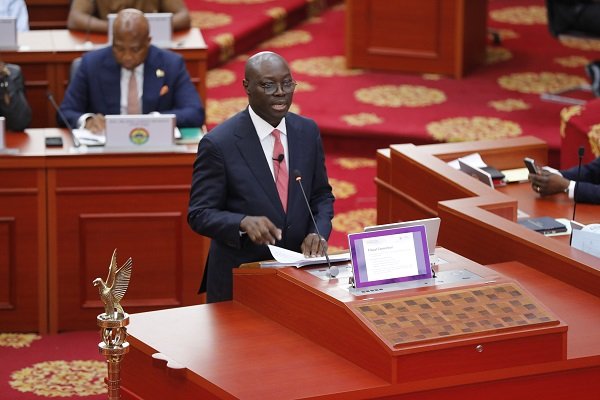
The government will not rush back to the international capital market despite improved sovereign ratings and renewed investor interest, the Minister of Finance, Dr Cassiel Ato Forson, has said.
He explained that although Ghana’s strengthening macroeconomic fundamentals had restored investor confidence and reopened access to global markets, the government would proceed cautiously and place debt sustainability above fresh external borrowing.
Presenting the 2026 Mid-Year Budget Review in Parliament yesterday, Dr Forson said the country had made significant progress in restoring fiscal stability after the 2022 debt crisis.
He noted that three years ago Ghana could not borrow on the international capital market “at any price”, but the situation had now changed, with investors showing renewed interest.


“Today, the market is inviting us back. But we are not in a hurry,” he stated.
The minister said Ghana’s debt-to-Gross Domestic Product (GDP) ratio had declined to 45 per cent, meeting the statutory debt target ahead of schedule and earlier than projected under the International Monetary Fund (IMF)-supported programme.
He added that the latest joint World Bank-IMF Debt Sustainability Analysis had upgraded Ghana’s debt outlook from unsustainable in 2023 to sustainable in 2025, with the country’s risk of debt distress improving from high to moderate.
Dr Forson said prudent fiscal management had also reduced borrowing costs, saving the country GH¢4.2 billion in interest payments in the first half of the year.
He explained that lower treasury bill rates and government bond yields were easing borrowing costs for businesses and households, thereby creating opportunities for investment, expansion and job creation.
The Finance Minister further disclosed that Ghana had returned to the domestic long-term bond market, raising GH¢2.7 billion through its first seven-year Cedi-denominated bond since the 2022 Domestic Debt Exchange Programme (DDEP).
He, however, cautioned that significant debt obligations remained, with GH¢58 billion in DDEP bonds maturing in 2027 and another GH¢53 billion in 2028.
To meet these obligations, Dr Forson said the government had strengthened the Sinking Fund and, under the 2026–2029 Medium-Term Debt Management Strategy, would allocate seven per cent of non-oil tax revenue, along with proceeds from domestic bond issuances, towards future debt servicing.
On tax policy, the Minister said the removal of the Electronic Transfer Levy (E-Levy), Betting Tax, COVID-19 Health Recovery Levy, Emissions Levy and VAT on motor insurance had not adversely affected revenue.
On the contrary, he said non-oil tax revenue increased from 12.6 per cent of GDP in 2024 to 13.1 per cent in 2025, despite the abolition of those taxes and the introduction of no new ones.
BY KINGSLEY ASARE
ollow our WhatsApp Channel now! https://whatsapp.com/channel/0029VbAjG7g3gvWajUAEX12Q